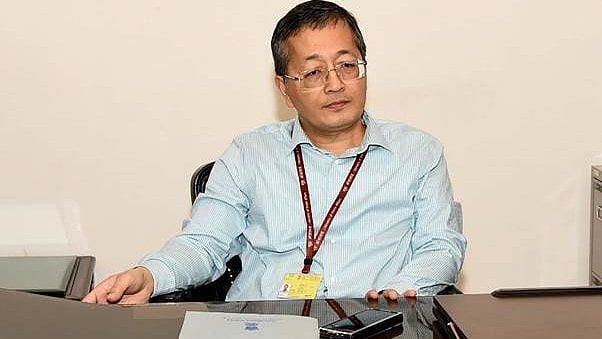
Expenditure Secretary V Vualnam. PIB photo
New Delhi: The central government will have to tread very carefully so that its fiscal targets and debt glide path are adhered to, considering the huge amounts that will be given to the states post the implementation of the 16th Finance Commission recommendations, Expenditure Secretary V Vualnam said on Monday.
The 16th Finance Commission, headed by Arvind Panagariya, has suggested a 41 per cent share of states in Central Taxes for 5 years beginning April 1, 2026. It has also suggested doubling of local bodies' grants, while doing away with the post-devolution revenue deficit grants for states.
In a post-Budget interview with PTI, Vualnam said that around Rs 14 lakh crore would be the share of states in Central tax collection as per the devolution formula of the Finance Commission.
Taking into account the grants as well as other schemes, like the Centrally Sponsored Schemes and Central Sector schemes, the amount which will go to the states from the government will be upwards of Rs 25 lakh crore, "The government has accepted (the recommendations), and we will have to tread very carefully so that our fiscal targets, our glide path and all are abided by," Vualnam said.
Continuing on the path of fiscal consolidation, Finance Minister Nirmala Sitharaman on Sunday pegged fiscal deficit at 4.3 per cent of GDP for the next fiscal, as against 4.4 per cent for the financial year ending March 2026.
The debt-to-GDP ratio is estimated to be 55.6 per cent of GDP in Budget Estimate (BE) 2026-27, compared to 56.1 per cent of GDP in Revised Estimate (RE) 2025-26.
A declining debt-to-GDP ratio will gradually free up resources for priority sector expenditure by reducing the outgo on interest payments, Sitharaman said.
The Central government targets to bring down the debt-to-GDP ratio to 50±1 per cent by 2030-31.
The 16th Finance Commission has recommended total grants for duly constituted Rural Local Bodies (RLBs) and Urban Local Bodies (ULBs) of Rs 7,91,493 crore for the period 2026-27 to 2030-31.