
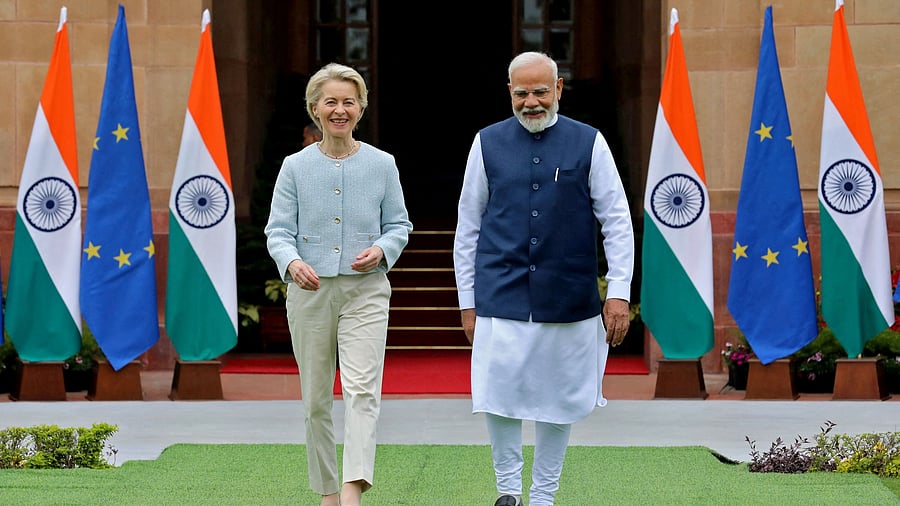
Prime Minister Narendra Modi with European Commission President Ursula von der Leyen.
Credit: Reuters Photo
India and the European Union (EU) are set to announce the much-awaited free trade agreement (FTA) on Tuesday after negotiations were finalised on Monday.
The deal is expected to boost the economies of India as well as the group of 27 European nations.
Commerce Secretary Rajesh Agrawal said on Monday said the deal is balanced and forward-looking from an Indian perspective, adding that it will help better economic integration of India with the EU.
"Negotiations have been successfully concluded. The deal has been finalised," Agrawal said.
The deal will be singed later in the year and could come into effect by next year. This is because it requires an approval from the EU Parliament as well as a nod from the Union Cabinet in India.
A long road
The talks for a trade deal concluded after 18 years of negotiations as they had begun in 2007.
The deal was termed as the "mother of all deals" by Commerce and Industry Minister Piyush Goyal, a sentiment that was mirrored by EU President Ursula von der Leyen at the World Economic Forum at Davos, Switzerland last week.
What to expect?
On Tuesday, Prime Minister Narendra Modi will hold summit talks with von der Leyen and President of the European Council Antonio Costa.
According to a PTI report, the deal is set to provide duty-free access to several Indian goods involving labour-intensive sectors such as textiles, chemicals, gems and jewellery, electrical machinery, leather and footwear.
Indian goods attract a tariff of 3.8 per cent in the EU but labour-intensive sectors are placed at 10 per cent. Meanwhile, the average duty of EU goods in India is about 9.3 per cent with high rates on automobile (35.5 per cent), plastics (10.4 per cent), and chemicals and pharmaceuticals (9.9 per cent).
Through the FTA, the two sides are expected to either eliminate or reduce import duties on over 90 per cent goods traded.
The FTA could also liberalise norms to promote trade in services sectors such as telecommunications, transportation, accounting, and auditing.
Why is the pact termed 'mother of all deals'?
Since 2014, the NDA government has singed seven such free trade agreements with Australia, the UK, Oman, New Zealand, the UAE, the EFTA bloc, and Mauritius.
However, the pact with the European Union is of special significance, especially at a time when India shares strained trade relations with the United States following President Donald Trump imposing 50 per cent tariff on all Indian goods, citing New Delhi's import of Russian oil.
The FTA with the EU is expected to help Indian exporters diversify their shipments and also helps reduce dependency on China.
Besides FTA, the two are also negotiating a pact in investment protection and Geographical Indications (GI). The India-EU FTA covers 24 chapters, including trade in goods, services and investment.
India-EU trade as it stands
In 2024-25, India's trade with the EU was worth $ 136.53 billion, including exports worth $75.85 billion and imports worth $60.68 billion, making the EU India's largest goods trading partner. The services trade in 2024 was $83.10 billion.
India has a trade surplus of USD 15.17 billion in 2024-25.
The EU market accounts for about 17 per cent of India's total exports, and the bloc's exports to India constitute 9 per cent of its total overseas shipments.
India's major goods exports to EU in FY25 included petroleum products ($15 billion); electronics ($11.3 billion, including smartphone worth $4.3 billion); textiles ($1.6 billion, including garments $4.5 billion); machinery, computer ($5 billion); organic chemicals ($5.1 billion); iron and steel ($4.9 billion); gems and jewellery ($2.5 billion); pharma ($3 billion); auto parts ($1.6 billion); footwear ($809 million), and coffee ($775 million).
The main imports from the EU included machinery, computer ($13.0 billion); electronics ($9.4 billion, including mobile phone parts worth $3.7 billion); aircraft ($6.3 billion); medical devices, scientific instruments ($3.8 billion); gems and jewellery ($3 billion - rough diamonds USD 1.7 billion); organic chemicals ($2.3 billion); plastics ($2.3 billion).
India's key services exports to the EU were other business services, telecommunication and IT, and transportation services. Imports included intellectual property services, telecommunication and IT.
(With PTI inputs)