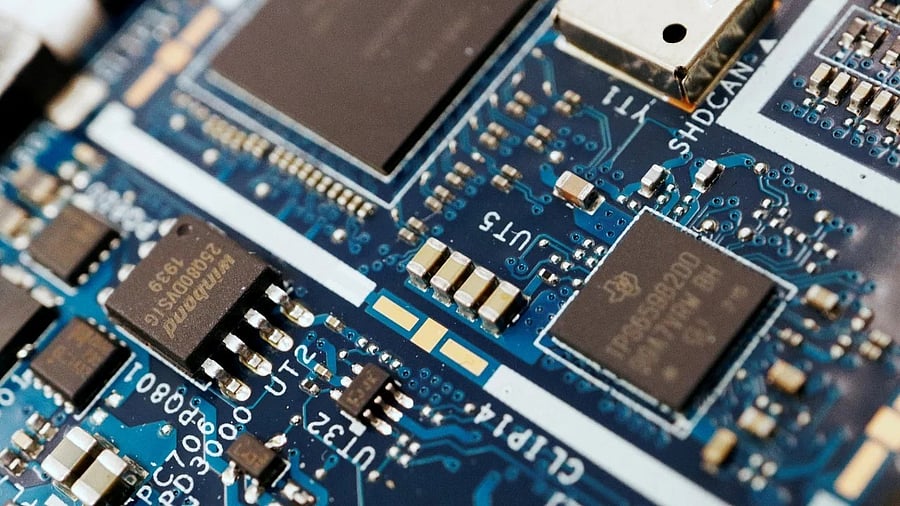
Representative image for a semiconductor.
Credit: Reuters Photo
Bengaluru: The reduction of US tariffs to 18% will significantly improve the country's position in global semiconductor, electronics and tech ecosystems. Industry analysts said this comes at a time when global firms are expanding or enhancing their production capacity in the country.
For US chip companies reassessing supply-chain concentration risks, cost predictability, and long-term economics are critical. This move brings Indian OSAT (Outsourced Semiconductor Assembly and Test)) services closer to global benchmarks, particularly when compared with Southeast Asian alternatives, Shetal Mehta, Co-founder, Suchi Semicon, said.
Also, the timing is equally important. Semiconductor firms are actively diversifying assembly and testing operations beyond traditional hubs. "Indian OSAT facilities today offer scalable capacity, improving yields, and quality systems aligned with international standards. A clearer tariff framework reduces friction in commercial negotiations and enables structured discussions around volume commitments and long-term partnerships," Mehta said.
According to him, this policy shift improves the country's chances of being included in multi-year backend manufacturing programmes rather than short-term pilot engagements. It supports higher utilisation of domestic OSAT capacity, encourages fresh capital investment, and strengthens the country's role in global semiconductor supply chains at a time when reliability and geopolitical neutrality are key decision factors.
The vision of $500 billion bilateral trade can have over $100 billion trade for the electronics and semiconductor sector, said Ashok Chandak, President of SEMI India and IESA.
"By improving market access, enabling smoother flow of capital equipment and advanced technologies, and—when complemented by the iCET and TRUST initiatives—strengthening trusted supply chains and deepening technology collaboration, the agreement significantly enhances India’s attractiveness as a global manufacturing and innovation hub," Chandak said.
It will accelerate semiconductor design and manufacturing, boost electronics value addition, and expand cooperation across AI, data centres, and advanced manufacturing—creating high-skill jobs and positioning India as a strategic and reliable partner in the global technology value chain, he added.
Industry leaders also said that lower US tariffs will improve the commercial viability of chips designed in the country. Nikul Shah, Co-founder and CEO of IndieSemiC, said Indian fabless firms already possess strong design talent, domain expertise, and cost efficiency. Improved tariff economics make collaboration with US customers more practical and competitive.
Electronics have emerged as the country's third-largest and fastest-growing export category in 2024–25. In the first half of FY26, electronics exports stood at $22.2 billion.
"Equally significant is India’s decision to eliminate tariffs on US technology imports. Better access to semiconductor IP, EDA tools, and design ecosystems enables Indian companies to move beyond mature nodes toward more complex and application-specific designs. This supports deeper engagement with US OEMs and Tier-1 suppliers," Shah added.