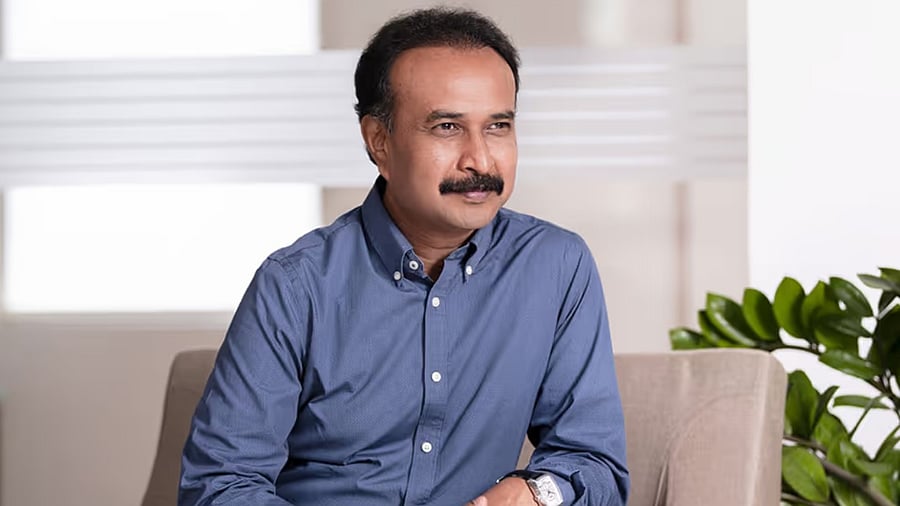
Accel India Founding Partner Prashanth Prakash
Credit: Accel India website
Bengaluru: In conversation with DH’s Uma Kannan, Accel India Founding Partner Prashanth Prakash discusses the startup funding landscape, highlighting robust early-stage funding in AI and deep tech, and noting that overall funding levels in 2026 are expected to remain similar to the previous year. Edited excerpts:
Startups raised only $10.79 billion in 2025, a 15% decline compared to 2024. What are the reasons for this slowdown?
There is definitely a lack of funding for Series B and C rounds that are upwards of $20-$50 million. But when it comes to early-stage, there is no scarcity across AI, deep tech and some consumer segments. There is sufficient capital for about $3-$8 million pre-series and series A rounds. Not just in India, but globally, there is a shift towards deep tech. IT-based technologies — whether it is for defence, space tech, advanced manufacturing, robotics, semiconductors or biotech — are seeing global demand. There is a lot of import substitution that can happen across these deep tech sectors. There is a really high-value market in India if companies are able to deliver products at a global level with both quality and competence.
Will non-AI sectors also receive funding in the coming days, as the focus shifts towards AI?
There are enough sectors for entrepreneurs to look at between AI/deep tech and consumer. There is still interest in the consumer sector. Capital will back companies that strengthen domestic supply chains.
Many startups went public in 2025, enabling several venture capital (VC) firms to successfully exit with huge profits. Will this continue in 2026? Are VCs prioritising profitability over growth?
IPO buoyancy is likely to remain similar to last year. There is a significant shift towards companies that are able to demonstrate the ability to get to Rs 50 crore - Rs 100 crore of Earnings Before Interest, Taxes, Depreciation, and Amortisation (EBITDA) within 7- 8 years of operation. Earlier, VCs were more comfortable trading growth for profitability, but now they are more moderate in their expectations of growth and with a stronger emphasis on achieving profitability by the seventh or eighth year.
During the Covid period, in 2021, startups raised a record equity funding of $38.93 billion. Do you think that will happen in the coming year, or will this funding winter continue?
We are unlikely to see that level of funding this year too. This year will be largely similar to last year. In my opinion, one should not position this as a funding winter. This is a kind of selective bias towards certain sectors and a shift towards profitability, a change in investing paradigm and sector of preference, rather than positioning this as a funding winter.
Given the current market scenario, what should founders focus on?
Founders should pick sectors around products that are anchored in some novel technology, IP and engineering so that it will be difficult for somebody to replicate those products. The focus should be to build something foundational, making their company irreplaceable in a larger system, rather than optimising for speed or surface-level differentiation.