
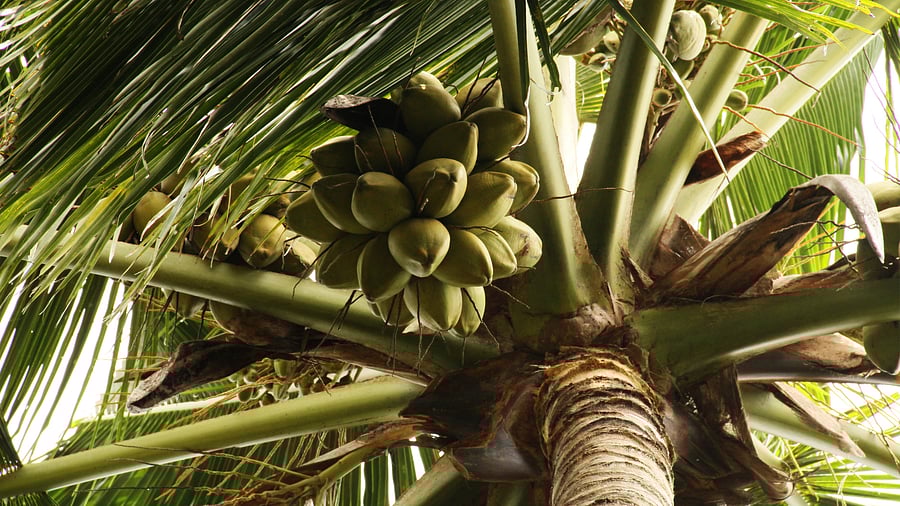
Representative image of a coconut tree
Credit: iStock Photo
New Delhi: Focusing on high-value plantation crops grown mostly in southern India, Union Finance Minister Nirmala Sitharaman on Sunday announced the launch of schemes to promote coconut, cocoa, cashew, and sandalwood.
The initiatives aim to diversify farm outputs, increase productivity, and create new employment opportunities.
"We will support high-value crops such as coconut, sandalwood, cocoa, and cashew in our coastal areas. Agar trees in the North East and nuts such as almonds, walnuts, and pine nuts in our hilly regions will also be supported," she said.
Pointing out that India is the world’s largest producer of coconuts, she noted that about 30 million people, including nearly 10 million farmers, depend on coconuts for their livelihood.
"To further enhance competitiveness in coconut production, I propose a Coconut Promotion Scheme to increase production and enhance productivity through various interventions, including replacing old and non-productive trees with new saplings, plants, or varieties in major coconut-growing states," she said.
The Minister announced a dedicated programme for Indian cashew and cocoa that aims to make the country self-reliant in production and processing, enhance export competitiveness, and transform them into premium global brands by 2030.
The government will also partner with state governments to promote sandalwood cultivation and post-harvest processing "to restore the glory of the Indian sandalwood ecosystem," which is closely linked to India's social and cultural heritage.
For hilly regions, a dedicated programme will support the rejuvenation of old orchards and the expansion of high-density cultivation of walnuts, almonds, and pine nuts, with a focus on value addition through youth engagement.
Tax Collection at Source (TCS) for tendu leaves will be reduced to 2 per cent.
Nirmala Sitharaman also unveiled a comprehensive package for the livestock, fisheries, and high-value agriculture sectors in the Budget 2026-27, seeking to reduce dependence on traditional crop farming.
The government allocated Rs 1,62,671 crore for agriculture and allied activities for 2026-27, up 7.12 per cent from the revised estimate of Rs 1,51,853 crore for 2025-26.
According to NITI Aayog officials, high-value agricultural products recorded higher growth during the period between 2014-15 and 2023-24 compared to low-value products such as cereals, oilseeds, and common vegetables.
"The emphasis on high-value crops, crop diversification, post-harvest processing, and region-specific programmes for coconut, sandalwood, and nut crops is a positive step towards improving farmer incomes and reducing production risks," said M K Dhanuka, Chairman, Dhanuka Agritech Limited.
The announcement of AI-based platforms like Bharat Vistaar, which will provide customised advisories in local languages, is particularly encouraging. These initiatives can empower farmers to make better and more timely decisions at the field level, supporting productivity and efficient farm management, he added.