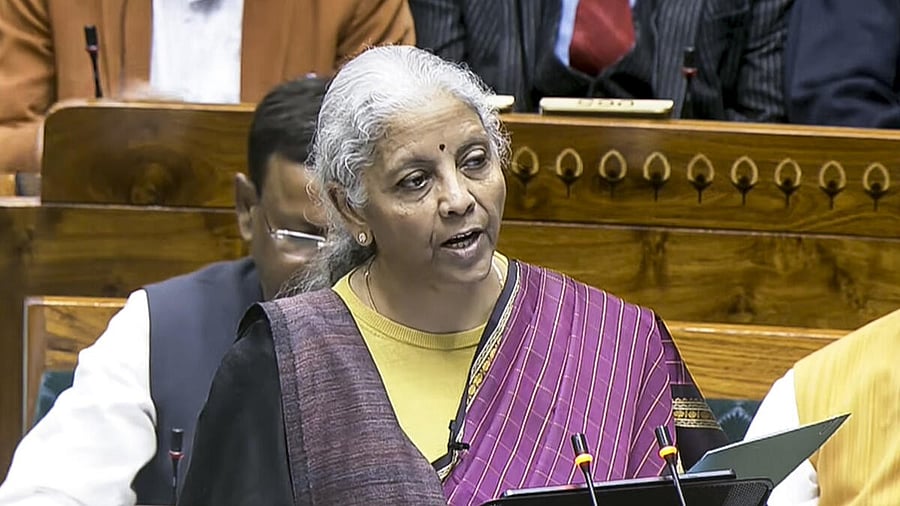
Finance Minister Nirmala Sitharaman.
Credit: PTI photo
For the Electronics Components Manufacturing Scheme, the Budget has proposed to increase the outlay to Rs 40,000 crore. The scheme, which was launched in April 2025, had an outlay of Rs 22,919 crore.
"India Semiconductor Mission (ISM) 1.0 expanded India’s semiconductor sector capabilities. Building on this, we will launch ISM 2.0 to produce equipment and materials, design full-stack Indian IP, and fortify supply chains. We will also focus on industry-led research and training centres to develop technology and a skilled workforce," Finance Minsiter Nirmala Sitharaman said during her Budget speech.
Rahul Garg, Founder & CEO, Moglix, said this launch of India Semiconductor Mission 2.0 represents a major milestone for India’s technology manufacturing ambitions. "By focusing on equipment manufacturing, materials, full-stack chip design and domestic intellectual property, the programme addresses critical capability gaps. The additional Rs 10,000 crore Shakti initiative and industry-led training centres will further strengthen the talent pipeline and supply chain resilience, accelerating India’s semiconductor self-reliance.”
The Union Cabinet approved the ISM with a Rs 76,000 crore outlay to boost fabrication, design, and manufacturing, and between 2023 and 2025, there has been a rapid setup of major facilities by domestic and foreign firms with significant investments.
According to the government, the total approved projects under ISM reached 10 with cumulative investments of around Rs 1.60 lakh crore in six states. Last year, the country also inaugurated its first centres for advanced 3-nanometer chip design in Noida and Bengaluru.
Lakshminarayanan Ramalingam, COO, Quest Global, said the Union Budget 2026 sends a strong signal that India is moving decisively from sector-specific interventions to building strategic, interconnected industrial ecosystems. The expansion of the India Semiconductor Mission 2.0, coupled with higher outlays, PhD funding, and AI-focused research investments, reflects a clear understanding that long-term competitiveness in semiconductors will be driven by deep R&D, advanced skills, and indigenous IP creation rather than manufacturing alone.
The finance minister also announced dedicated rare earth corridors in Odisha, Andhra Pradesh, Tamil Nadu, and Kerala.
Anil Agarwal, Chairman of Vedanta Ltd, has welcomed the government's keen attention to critical minerals and rare earths. "The Rare Earths Corridors for mining, processing, R&D and manufacturing in Odisha, Tamil Nadu, Andhra and Kerala will boost growth, employment and mineral security. Import duty exemption on capital goods for critical minerals processing is very timely in the current global scenario," he said.