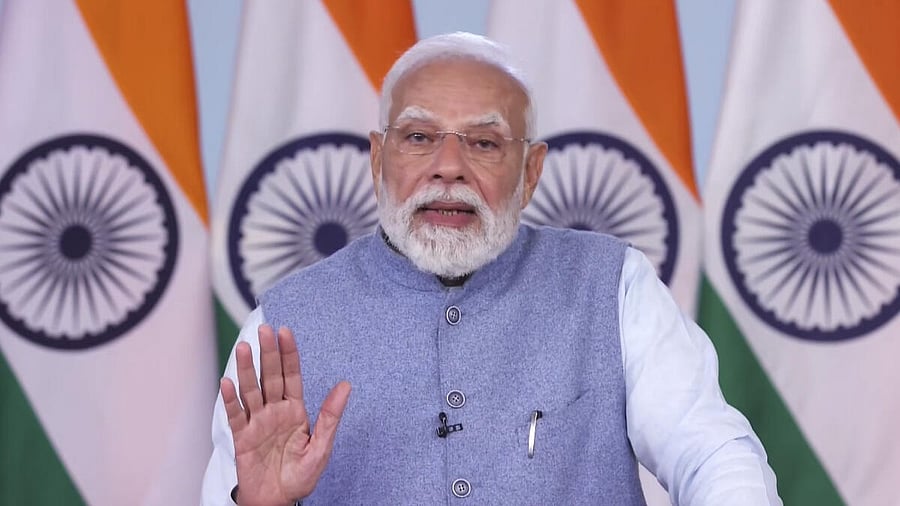
PM Narendra Modi
Credit: @NarendraModi/YT via PTI Photo
Indian Prime Minister Narendra Modi will seek to bolster fast economic growth and buffer the Asian nation from external shocks through domestic policy reforms in the latest budget on Sunday, as unprecedented global volatility weighs on the outlook.
Finance Minister Nirmala Sitharaman will present the budget for 2026-27 on February 1 at 0530 GMT.
India's economy has so far withstood punitive U.S. tariffs imposed by President Donald Trump, with growth forecast at 7.4 per cent for the year ending March 31 with the help of government spending on infrastructure and income and consumption tax cuts that boosted consumer spending.
However, that has cut revenue, limiting the government's opinions to support the economy in the new budget.
"Having announced a direct tax cut and a goods and services tax cut in 2025-26, there isn't enough room to offer further consumption stimulus stimulus in the 2026-27 budget in our view," said Aastha Gudwani, an economist at Barclays.
Sitharaman, economists said, faces the difficult task of restoring short- and long-term investor confidence, as uncertainty over New Delhi's trade talks with Washington has unsettled financial markets and sent the rupee to a record low.
Foreign investors have continued to sell Indian shares after a record outflow in 2025 on stretched valuations, subdued earnings and geopolitical concerns.
With limited capacity to boost spending, the government is likely to focus on simplifying regulations and pushing structural reforms to attract domestic and foreign investment, said Anubhuti Sahay, head of Indian Economic Research at Standard Chartered.
REVENUE CONSTRAINTS
Due to 2025's tax cuts the government is estimated to lose 1.5 trillion rupees in revenue annually, and economists expect Sitharaman to cut overall spending to meet this year's fiscal deficit target of 4.4% of GDP.
Sitharaman has stabilised the bond market and won a much-awaited rating upgrade from S&P Global Ratings with her predictable fiscal glide path.
Economists expect the latest budget will focus on bringing down the federal government's debt-to-GDP ratio from 56 per cent to 49 per cent-51 per cent by 2031, a metric closely watched by global investors.
The government is likely to aim for a fiscal deficit at 4.2 per cent of GDP for 2026-27 compared with 4.4 per cent of GDP this year, economists say, and gross borrowing is likely to rise to between 16 trillion rupees and 16.8 trillion rupees, from 14.6 trillion rupees this year.
This will constrain Sitharaman from significantly increasing capital expenditure beyond 12 trillion rupees, from the current year's 11.2 trillion rupees, and will hold government capital expenditure at around 3.1% of GDP, economists said.
INVESTMENT, MANUFACTURING PUSH
In an effort to spur private investment, the Modi government has introduced a spate of reforms in the past few months, including the nation's biggest overhaul in labour laws and opening up the guarded nuclear sector.
Further changes designed to draw more domestic private and foreign investment are expected in the budget, including plans to make it much easier for foreign firms to invest in defence companies with existing licences, Reuters reported.
It is also expected to increase defence spending by 20 per cent, which would be the largest increase in recent years.
The budget may make yet another push to boost local production following the Modi government's two failed attempts to boost manufacturing.