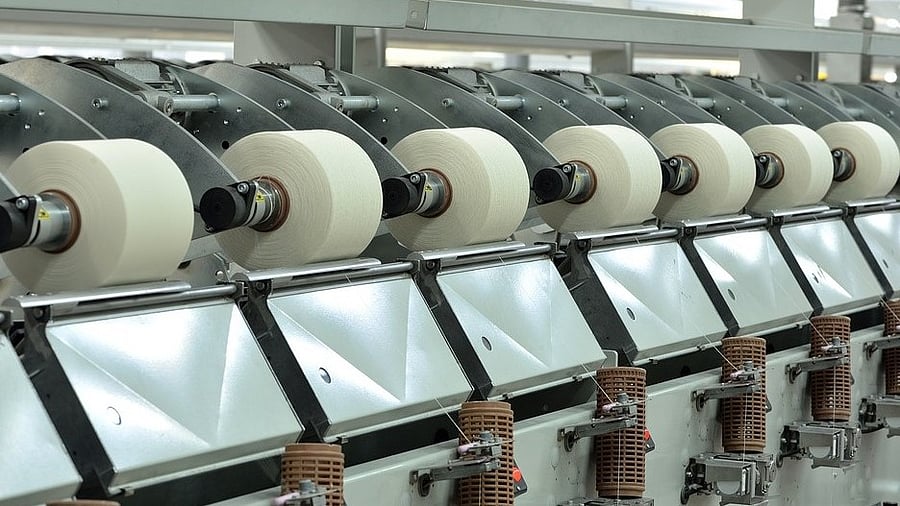
Representative image for textile sector.
Credit: Pixabay Photo
Chennai: Union Budget on Sunday proposed an integrated programme to boost growth in the labour-intensive industry, besides announcing mega textile parks and a new scheme named after Mahatma Gandhi to strengthen khadi, handloom and handicrafts sectors.
Finance Minister Nirmala Sitharaman said the integrated programme will have five sub-parts which includes initiatives to promote globally competitive and sustainable textiles and apparels and achieving self-reliance in natural fibres such as silk, wool, and jute, man-made fibres, and new-age fibres.
The announcement is significant since the textile hubs in the country, including Tiruppur, are focusing huge on man-made fibres. The sector is facing a critical time especially due to the 50 per cent tariffs imposed by the US on Indian imports and the announcement also comes at a time when there is a glimmer of hope due to the Free Trade Agreement signed with the EU.
The programme includes a textile expansion and employment scheme to modernise traditional clusters with capital support for machinery, technology upgradation and common testing and certification centres. Another measure is the launch of a National Handloom and Handicraft programme to integrate and strengthen existing schemes and ensure targeted support for weavers and artisans.
A Tex-eco initiative to promote globally competitive and sustainable textiles and apparels, and Samarth 2.0 to modernize and upgrade the textile skilling ecosystem through collaboration with industry and academic institutions are other initiatives under the integrated programmee.
Sitharaman also announced setting up of Mega Textile Parks in challenge mode to focus on bringing value addition to technical textiles, but gave no further details of where such parks will come up. She added that the Mahatma Gandhi Gram Swaraj initiative will help in global market linkage and branding.
Exporters and the textile industry in Tiruppur and Coimbatore welcomed the announcements as “constructive and positive” for the textile ecosystem and said the schemes announced signals a clear, outcome-oriented intent to modernise the sector, and accelerate their competitiveness in domestic and global markets.
Tiruppur Exporters’ Association (TEA) and The Southern India Mills Association (SIMA) said beyond sector-specific measures, reforms like enhanced credit availability guarantee covers for MSMEs, tailored credit cards and support for first-time entrepreneurs will benefit the sectors.
TEA President K M Subramanian said the Mahatma Gandhi Gram Swaraj Initiative will promote khadi, handloom and handicrafts at scale, while the proposed programme on handlooms will integrate and scale existing schemes to improve market access and value addition for artisans and small producers.
“The announced expansion to modernise traditional textile clusters and the focus on employment generation will directly benefit cluster economies and sustain millions of livelihoods,” he said and welcomed the emphasis on skilling and modernisation.
Subramanian also said the exemption of specified shuttle-less looms and other textile machinery from basic customs duty will lower capex barriers for modernisation, while adjustments to tariff lines for knitted fabrics and duty concessions for inputs used by exporters will support value addition and export competitiveness.
Durai Palanisamy, Chairman, SIMA, said the Budget has given a thrust to fuel the growth of the textiles and clothing industry and that the proposal of establishing training institutes and strengthening skill development would enable the industry to improve productivity and meet the skill requirements of the age machines and processes.
However, he said the Budget could have considered the removal of 11 per cent import duty on cotton as it was essential to meet the quality cotton shortage and meet export commitments.