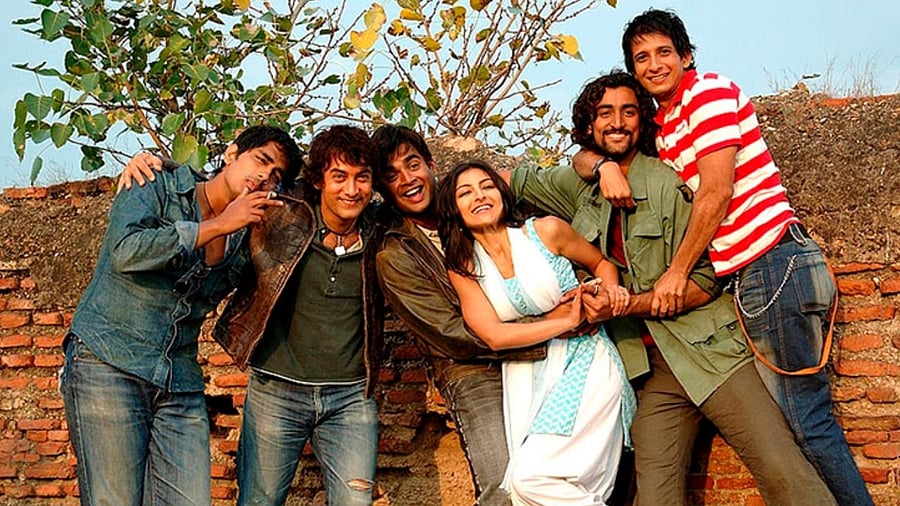
Rang De Basanti (2006)
Credit: Rakeysh Omprakash Mehra Pictures
Mumbai: What made the young during the struggle for Independence put down the pen and pick up a gun? That question and Bhagat Singh writing from jail that freedom has to be from humans exploiting humans were the starting points for "Rang De Basanti", says Rakeysh Omprakash Mehra as his film completes 20 years.
Poet Sahir Ludhianvi was another guiding light for the film, which opened in theatres on January 26, 2006, the Republic Day release carefully chosen to maximise the potential of its theme of youth and idealism.
"Sahir's poetry, ‘Bahut dinon se hai yah mashghala siyasat ka, ki jab javaan hon bachche to qatl ho jaayen…’ was pasted on this wall right here. I wrote the film looking at that every day," Mehra told PTI quoting the famous lines that loosely translate as "It has long been the pastime of those in power that when our children grow up, they are sacrificed."
His film, remembered well for its songs and its content, explores the story of young revolution through the eyes of four carefree college friends. It operates on two tracks -- that of the four young men who are roped in for a documentary on Bhagat Singh and the deeply emotive and inspirational struggle of Bhagat Singh, Rajguru, Chandrashekhar Azad and Ashfaqullah Khan.
The film, which went on to become a huge critical and commercial hit, slips in and out of the two tracks, intersecting and eventually becoming one thematically.
"It (film) was a call to the youth, to stop sitting on the fence and settling in America, and instead focus on building your own country. It's not easy to build a nation, it takes a generation to do that. I still feel that, until the youth jump into the middle of everything, real change is far away," Mehra told PTI.
The movie, with an ensemble cast including Aamir Khan, Kunal Kapoor, Siddharth, R Madhavan and Waheeda Rehman, is 20 years old but its messaging and social impact is as relevant today as it was then, Mehra said.
The director, also known for "Delhi 6" and "Bhaag Milkha Bhaag", said "Rang De Basanti" was his second film and the entire team relied on intuition without worrying about success.
"What made the youth of that time put their pen down and pick up a gun? What inspired them?' It always intrigued me," Mehra said.
"In one letter Bhagat Singh wrote from jail, he had said, ‘We don't want freedom from the goras (British), to be enslaved by ourselves, our own. So, the freedom has to be from humans exploiting humans. And today, we will get freedom from the English, because our people will exploit us’. I must say, his prophecy came true, sadly so. We are fiercely divided into rich and poor, haves and have nots as a nation."
While casting for the film, Mehra found actors who perfectly suited the dual roles they had to play in the movie, which begins with a young British woman trying to recruit Delhi University students for the documentary.
When one of their friends is killed in a MiG crash, the students decide to take up arms and fight corruption in defence deals.
The film's title was inspired by the street plays that Bhagat Singh and friends performed during Baisakhi fairs.
The initial idea, Mehra said, was to make a film on young revolutionaries and the Kakori train robbery, the assassination of John Saunders and Jallianwala Bagh killings. Mehra and writer Kamlesh Pandey wrote a story around it and called it "The Young Guns of India".
But when they narrated the story to a young group in Mumbai, they did not find the connect they were looking for. The young men and women were busy planning their career and settling abroad.
Mehra did the same experiment in Delhi but the results were more disheartening.
"They were throwing things like 'if Bhagat Singh was here today, he would have taken an army job or a bank job', which broke my heart... But then this story emerged. So two parallel worlds, one in the 1920s, and another in 2000... They crisscross."
Growing up in Delhi, Mehra said India Gate was his playground and he would often stop to pay respects at the Amar Jawan Jyoti, a memorial to honour Indian soldiers who died in the 1971 India-Pakistan war.
“Patriotism is not thumping your chest, as per ‘Rang De Basanti’ and as per my belief (too), it's not pointing a finger to somebody else, to a neighbouring nation. Patriotism is more inclusive and it has a much higher meaning, it means that you have to get your hands dirty in running this country, and that was the final message of the film,” he said.
Making the movie came with its own set of challenges and budget issues, Mehra said, praising the team for sticking around for two years with him through thick and thin.
Finding a producer was also an uphill battle. Then producer Ronnie Screwvala stepped in to help.
"For the entire two years, I was struggling for money for this film. But for all those two years, AR Rahman, Aamir Khan, and they all (other cast and crew) stood by me and said, 'you make this film, you make it happen, one day or the other'.”
The film, because of its theme of youth taking up arms and going against the establishment, faced issues at the time of its release.
“ 'Rang De Basanti' was banned. We fought it out. Then finally the establishment saw the intention of the film. The film was viewed by the then defence minister Pranab Mukherjee, and the three heads of Army, Navy, and Air Force in a theatre in Delhi. So, it had gone up to that level.
"You don’t tell stories thinking about whether they will be allowed (to release) or not. Then stories will never come out if you think of the result and not the process,” Mehra said.
He added that Ludhianvi's lines "Khoon phir khoon hai, tapkega to jam jaayega" gave birth to the song "Khoon Chala" as well as the title song that was sung by Daler Mehndi and became an anthem in itself. The songs, composed by Rahman and some of the most popular tracks of the era, included "Pathshala", "Khalbali", "Luka Chhupi" and "Tu bin bataaye".
Two decades after the release of “Rang De Basanti”, Mehra hopes to once again address pressing issues through the medium of cinema.
"I'm working on two ideas, one is about the evil of social media and the other is about farmers' suicide because that is relevant today... Everyone is rich who is making tea or coffee, but the person who is feeding us, and growing food, is committing suicide? Shouldn’t we all ask ourselves the question and that’s the question I want to ask," he said.