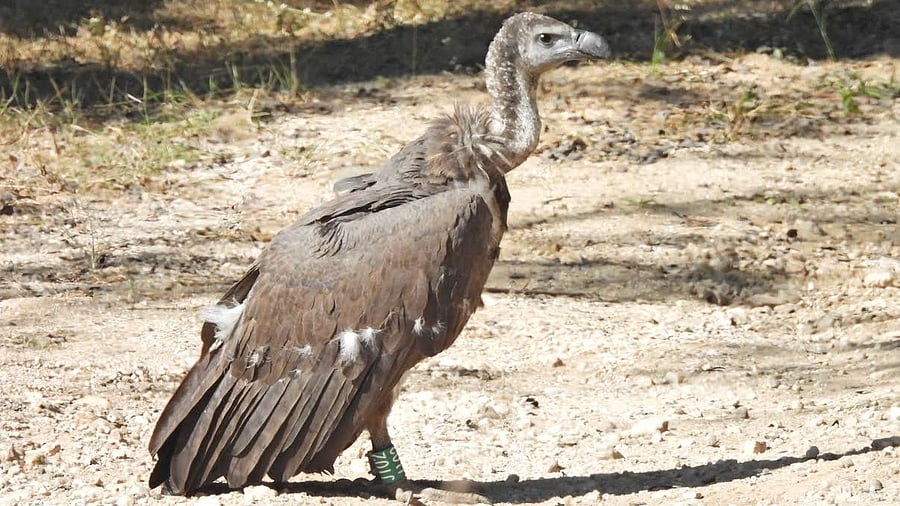
Vulture at the Pench Tiger Reserve (PTR) in Maharashtra.
Credit: Special Arrangement
Pench: In a landmark moment for India’s vulture conservation efforts under the Jatayu programme, two batches of captive-bred vultures released at different times have begun interacting successfully in the wild at the Pench Tiger Reserve (PTR) in Maharashtra’s Nagpur district.
Nestled in the lower southern reaches of the Satpura mountain range, PTR—spread across Maharashtra and Madhya Pradesh in central India—is famously known as the setting of Rudyard Kipling’s The Jungle Book and the fictional home of Mowgli.
In Maharashtra’s PTR, the Bombay Natural History Society (BNHS), in coordination with the Maharashtra Forest Department (MFD), has been implementing a phased vulture release programme. A key breakthrough occurred when vultures released earlier were observed guiding newly released captive-bred birds in adapting to the wild.
“In fact, the suspense finally broke when previously released vultures, which had learnt to survive in the wild, came to the rescue of captive-bred vultures and taught them their first lesson on taking flight in the wild,” said BNHS Director Kishor Rithe.
PTR-Maharashtra and BNHS had released 10 Long-billed Vultures in August 2024. Of these, two birds were later sighted roaming across tiger reserves in Maharashtra and Madhya Pradesh, indicating healthy dispersal and survival.
Another batch of vultures was brought from Pinjore in Haryana on April 24, 2025, and trained to feed independently on carcasses. The second batch—comprising 14 vultures—was released on Wednesday, following the successful August 2024 release.
BNHS fitted GSM-GPS transmitters on these birds last month to enable post-release monitoring. On December 11, 2025, the gate of the vulture pre-release aviary at PTR was ceremoniously opened to initiate the soft release of eight White-rumped Vultures (Gyps bengalensis) and five Long-billed Vultures (Gyps indicus).
The gate was opened by Principal Chief Conservator of Forests (Wildlife) Srinivas Reddy, BNHS President Praveen Pardeshi and PTR Deputy Director Akshay Gajbhiye, formally marking the commencement of the soft-release process. Dr Mayur Pawashe, expert veterinarian at the Wildlife Research and Training Centre (WRTC), Gorewada, Nagpur, was also present.
Following established soft-release protocols, the aviary gate was kept open continuously, allowing vultures to exit voluntarily when they felt safe. Food was provisioned outside the aviary to encourage natural feeding behaviour and facilitate interaction with wild conspecifics.
On December 12, 2025, a highly encouraging development was recorded when vultures from the 2024 release batch and birds from the current 2025 batch were observed feeding together at the designated site.
Rithe said the early interaction between previously released and newly released vultures was a strong positive behavioural indicator, reflecting site fidelity, social facilitation and successful integration of the new birds into the local vulture population. “This time, wild vultures were also observed soaring and perching around the aviary during the release, indicating habitat suitability and reinforcing the effectiveness of the release strategy,” he added.
A total of eight White-rumped Vultures and five Long-billed Vultures are part of the current release process. One White-rumped Vulture (Z33) remains under veterinary treatment and will be released once deemed medically fit.
All released vultures are fitted with GPS transmitters, enabling long-term monitoring of their movement, habitat use and survival. The data generated will support scientific evaluation of release outcomes and help guide future vulture conservation efforts in the central Indian landscape.