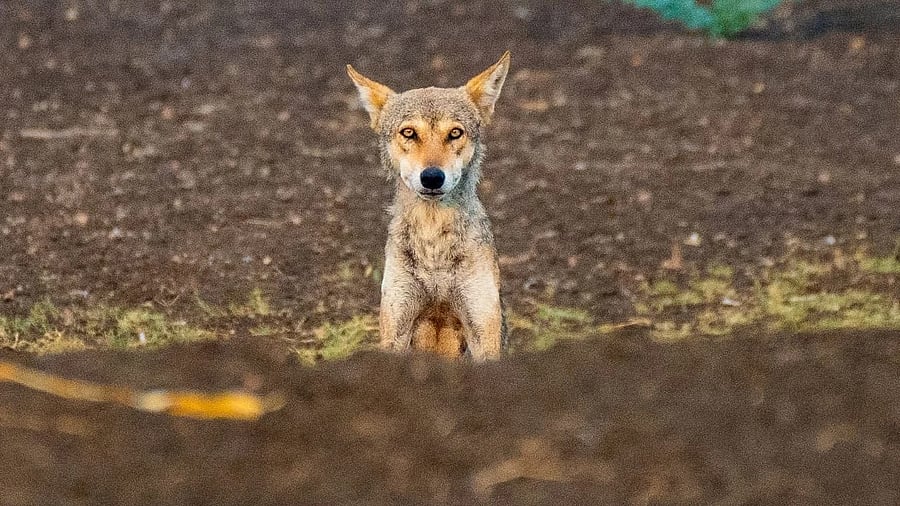
Credit: Special Arrangement
Hubballi: Younger shepherds no longer consider wolves their ‘guardian gods’ and consider any lifting of livestock as a loss and threat to livelihood, says a recent study, indicating a generational shift in conservation.
The study is part of a collaborative effort to understand social perspectives in wolf conservation between Europe and India.
It was led by Salvador Lyngdoh, scientist from Wildlife Institute of India, and Filippo Favilli of Eurac Research, Italy. It highlights that earlier shepherds used to consider loss of livestock due to wolves as part of the profession.
But today, the younger generation faces severe financial crisis and lacks awareness on compensation mechanisms.
They have been demanding the government’s intervention to curtail the population of wolves. With no succour, they sometimes resort to killing the wolves.
A 2001-04 survey conducted in the state by a team led by Honnavalli N Kumara recorded the presence of 555 wolves in 19 districts of the state.
A 2022 study by Yadvendradev Vikramsinh Jhala, senior scientist with National Centre for Biological Sciences, Bengaluru, (through MaxEnt model), says there are fewer than 72 individual wolves in the wild in Karnataka.
With declining natural prey base like blackbucks and other grassland species, wolves are completely dependent on domesticated livestock for survival. This is resulting in conflict.
Conversion of grasslands into agriculture fields, change in agriculture practices, drop in prey base and presence of leopards in habitats are considered reasons for the decline in the population of wolves.
With changing behaviour of shepherds, experts believe wolves stand no chance to survive for long. “There is a major shift in the attitude of shepherds towards wolves. This is a matter of concern. Communities which never used to kill wolves are now lacing carcasses of livestock with poison. This leaves no chance for wolves to survive,” says Jhala. He says development work, especially building of highways, is resulting in local extinction of wolves from several grassland habitats.
The study highlights that the economical impact of predation by wolves is resulting in increasing conflict.
“Shepherds above the age of 30 years still consider wolves as their Biroba, Beerappa or Beeranna (Gods) and will not react to wolves lifting livestock. On an average, each shepherd with 60-150 livestock is losing 10-20 sheep/goat due to predation. Such a loss, without compensation, will have a huge economical impact on herders’ families,” says Salvador.
He says earlier shepherds believed that the presence of wolves will keep their herd healthy by hunting the weakest one. But today, with hardly any compensation, younger shepherds consider wolves a threat and seek government’s intervention to control their birth rate.
“Shepherds do not wish to kill wolves, but they do not want the animals to stay around them,” says Salvador.
He says there is a need to take pastoral communities into confidence to conserve the predators of grasslands to maintain ecological balance and prevent land use change.