Christmas in Goa has always had its own timbre. By the time ‘season’ unfurls in October, beaches fill with sun-seekers fleeing European winters. It is a time of warmth and celebration. As heady aromas of plum cakes and bebincas sweeten the air, strains of evening carols drift through the vaddos. In paddy fields, nativity scenes appear like gentle apparitions, often lit by flickering lanterns and decorated with coconut fronds and barn animals sculpted in clay.
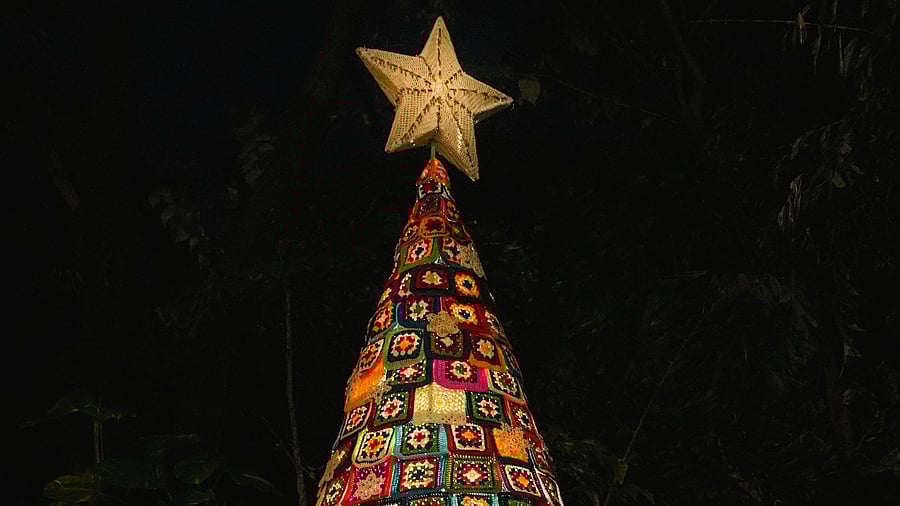
Far from the beaches and fields, however, a very special Christmas tree claims pride of position this year. Just across the threshold of the Museum of Goa (MOG), an 18-foot Christmas tree rises — not from pine and tinsel, but from nearly a thousand hand-crocheted squares. Each eight-inch piece, crafted by a collective of 25 women from across Goa, has been lovingly stitched onto a metal framework.
The story of this tree is one of serendipity and community. It was conceived by the newly formed Crochet Collective Goa, a group that came together in August, united by their shared love for yarn and craft.
“The Christmas tree is a result of wanting to build a community around crochet and bring crochet from the craft space into the art space. With this end in mind, 25 women across Goa got together and formed the Crochet Collective Goa. We hope to work on many more projects together because we see the smiles the tree brings to people’s faces and because we ourselves enjoyed every bit of the process,” says Sharmila Majumdar on behalf of the Crochet Collective Goa.
The tree is a result of collective intent. Standing 18 feet tall from base to star, with a two-foot topper and an eight-foot diameter, it rests on a steel framework donated by a young civil engineer.
What truly differentiates this tree, however, is not just its size but its texture. “We didn’t want a flat, carpet effect. We wanted dimension,” Sharmila explains. To achieve this, the team mounted a mesh over the metal skeleton to support each square. These were then hand-stitched, one by one, directly onto the frame, creating a surface that feels sculptural and richly textured.
The project emerged almost accidentally. In August, crocheters across Goa —bankers, teachers, retirees, home-based entrepreneurs, women in their 30s through their 60s — responded to a simple WhatsApp call put out by crocheter Sheena Pereira. “We didn’t know the scale, we didn’t know the venue, we didn’t even know each other,” Sheena laughs. “But we knew we wanted to make something together.”
Alongside Sheena were Sophie, who helmed strategy, and Sharmila Majumdar, a lifelong knitter who turned to crochet just five years ago. “Crochet is calming, almost spiritual,” Sharmila says. “In this day and age, if you’re not doing something with your hands, you’re doomscrolling. Crochet keeps you grounded; it keeps you sane.”
The assembling of the tree took place at Sharmila’s home, much like a giant Lego project, where the metal frame stood waiting. “That was the first time many of us stood in the same room,” Sharmila recalls. “To watch these anonymous squares suddenly find their place on the tree — it was deeply emotional.”
Their work found its perfect home when the Museum of Goa invited the collective to exhibit the piece as part of its milestone 10th anniversary exhibition, Festivals of Goa.
MOG’s exhibition celebrates nearly 50 micro-festivals of Goa, from well-known feasts to lesser-known village rituals shaped by layers of Hindu, Catholic, and regional traditions. Goa, after all, does not offer a single culture but a mosaic.
“As we celebrate MOG’s 10th anniversary through Festivals of Goa, the crochet Christmas tree adds immense value to this milestone. Christmas is one of Goa’s most cherished festivals, embraced by people of all religions and backgrounds. The tree, therefore, becomes a symbol not just of festivity, but of Goa’s syncretic spirit — where traditions meld, evolve, and bring people together,” says Sharda Kerkar, Director of the Museum of Goa.
Across India, crochet has quietly surged back to life. Lockdowns in 2020 nudged people toward handwork, while celebrity athletes like swimmer Tom Daley, casually knitting and crocheting between games, helped uphold crafting as a mindful practice.
The tree remains on view until January 18, 2026, at the Museum of Goa, after which the squares may be repurposed into blankets and sold to raise funds for local orphanages.