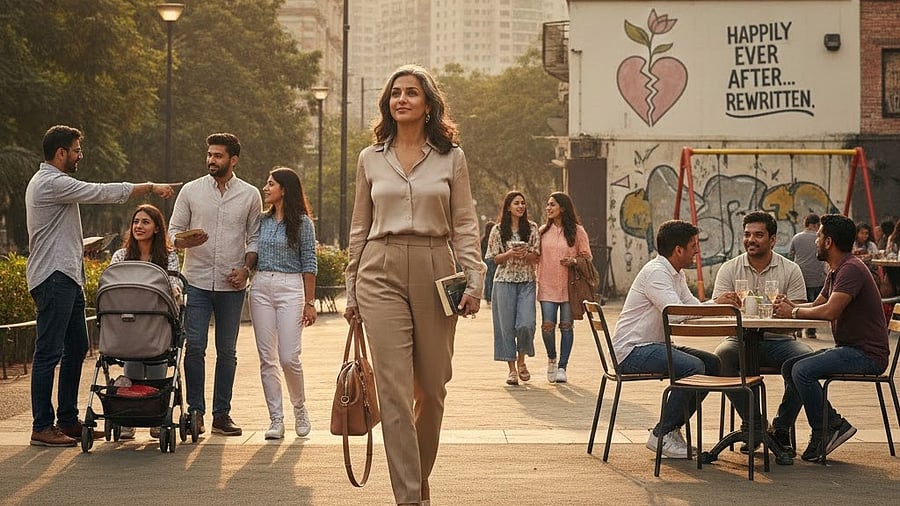
Image of a middle aged woman walking through a bustling street.
AI generated image
The idea of ‘happily ever after’ is no longer tied to remaining married. Love isn’t guaranteed, and life-long love even less so.
Plenty of women are refusing to stay in marriages where the relationship has met its demise or plateaued. And then there are women who’re refusing to marry at all, because the idea of ‘settling’ is anathema to them.
Either way, the story is the same: the expectations have changed, but the world around them hasn’t. Women are leaving marriages because they want more — and discovering the world hasn’t developed enough partners to match that desire. Not because society disapproves.
The eyebrow-raising that accompanied the news of divorce in urban India has lost some of its voltage today. But the inventory of emotionally mature, financially stable men who can offer them companionship with the side order of a little love, if not romance, is limited.
‘Shrunken’, ‘curdled’ dating pool
Nayantara, the newly single-at-40 protagonist of my novel, finds that “not only has the dating pool of eligible men her age shrunken, but it has curdled as well.”
Nayantara may be a fictitious character, but fiction, as we know, comes from real life — and we all know women who’ve walked out of marriages in their 30s and early 40s not necessarily because there was adultery or abuse (of course those reasons persist), but because of a demise. The relationship’s demise. These women are mostly financially independent, successful, able-bodied and confident, but they’re realising that — to borrow from Coco Chanel — “they have become the men they wanted to marry.”
You take financial dependence out of an equation and the number of women leaving marriages is likely to grow.
Initially, there is optimism. I’ve seen enough women come out of marriages in their 30s — wiser, more self-assured, no longer naïve and yet absolutely certain that love is on the cards.
The longing to have another person witness our highs and lows, someone to adore us for our quirks and forgive us for our inadequacies even as they share a roof with us — that longing is only human.
But after a few disappointing dates, short-lived relationships and situationships that end before the valet brings the car around, these women begin to see a pattern.
The problem isn’t the women. It’s the options. Too many men in this age bracket are carrying oversized baggage with their past spilling out of it, leaving a trail behind them.
Now, don’t take it the wrong way — I am only an observer, a witness to the disappointments and an admirer of the clarity of mind and self-posession of these women.
Better off being single?
“Better to be single than be with someone who drains the life out of you,” or “Better to be single than listen to his sob stories about his ex-wife,” is the common sentiment I hear from my single girlfriends. And this is the cultural shift not enough people are talking about: that women would rather remain single than compromise downwards just to regain a plus-one.
They’d rather live well, spend well, sleep well, breathe freely — than enter a lopsided arrangement with emotionally dented men who either become insufferable bores or smooth-talking salesmen so convinced of their greatness that they wouldn’t let you forget it for a second.
For the first time in our country, women — even as they make sense of not being wholeheartedly embraced by the kingdom of couples — are choosing the single life in their 40s because they would rather learn to love their own company than tolerate that of a man less deserving of them.
Women are choosing to remain single not out of defeat, but discernment.
But not finding a companion without baggage or a bad personality is only part of the problem of being single. Not finding a place on the social seating chart or someone to invite you to join them on a holiday is a kind of unhappiness that married people cannot even begin to fathom.
Scripture teaches us that we come alone into this world and leave it pretty much the same way. Loving your own company, learning to be alone (which we’re told is different from being lonely), cultivating enough abiding interests to occupy our free hours — these are all exercises that teach us to be self-sufficient and happy.
But that desire to be included — it’s human. Our social structure is built only for pairs. Society only understands even numbers. Married people, while making a list for a dinner party, often leave out their single friends navigating midlife on their own. Couples plan their vacations with other couples, and parents of young children with other parents of young children.
If the shoe doesn’t fit, they don’t want to wear it. And they’ve made their peace with walking alone; it’s the world that doesn’t quite understand it yet.
(The author has just released her new novel, The Wrong Way Home, with Bloomsbury India.)