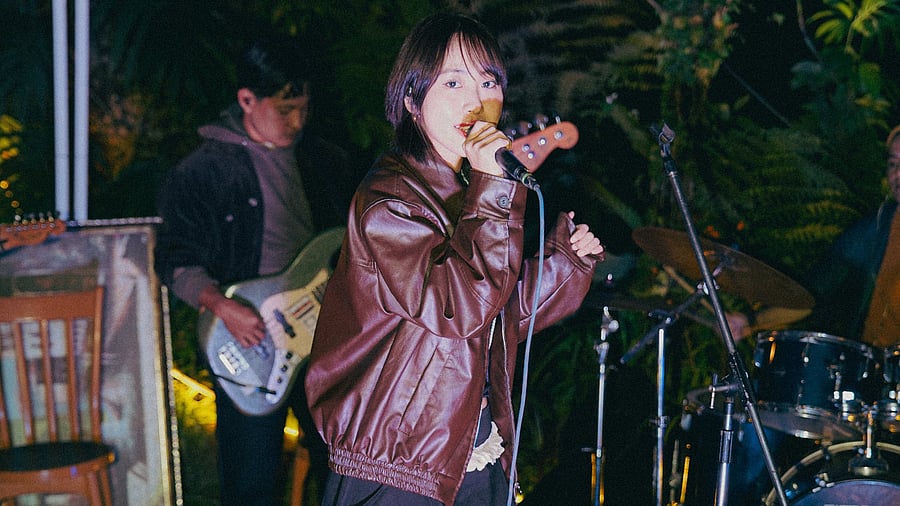
Credir: Special arrangement
When Nagaland-based singer-songwriter Temsu Clover (Temsukala Lemtor) stepped on stage at BLR Hubba on Friday, it marked her long-awaited debut in Bengaluru — a city she has always wanted to perform in. Though this was only her second visit, the connection felt “instinctive”. For Temsu, performing in a new city is like beginning a conversation with strangers. “Finally, my songs get to find new ears and new interpretations here,” she said.
Temsu’s music resists easy categorisation, drawing from blues, R&B, pop, and jazz. Her sound has evolved less through design and more through instinct. Growing up listening to a wide range of music, she learned to follow emotion rather than structure. “When I create, I don’t think about genre. I follow the music,” she stated.
Her roots in Nagaland play a vital role in shaping that sensibility. Music is woven into everyday life there. “Every household has a guitarist or a singer,” Temsu noted. Though her songs may not explicitly address identity, her journey carries the weight of being seen and heard from a region often underrepresented in the mainstream.
The 27-year-old artiste has released eight singles and one album to date, with most of her music centred on themes of emotions and life. Her single ‘Lost in my own town’ explores the struggle of trying to find one’s way while also accepting oneself in the process. She listens to various artistes, including BiBi, Lee Hi, and Laufey, drawn to the honesty and boldness in their songwriting.
Her single ‘Don’t wanna be’ features a minimal indie-pop style beat. The combination of her vocals with soft progressive beats creates a sound that is characteristic of Temsu’s style. Over time, Temsu’s songwriting has grown more restrained and intentional. Early on, she tried to say everything at once. Now, she values “saying less, but meaning more”.
As a storyteller, Temsu experiences different formats in distinct ways. Singles feel cinematic — self-contained moments — while albums unfold like longer series or seasons. Live performance remains central to that journey. Playing with her band — Imti Imchen on bass, Nungsang Kichu on guitar, Imli on drums, and E Pat on keys — transforms her music into something collective. Long a childhood dream, being in a band has reshaped how her songs breathe on stage. “The music becomes less about me and more about the feeling in the room,” she explains.
Looking ahead, she envisions a legacy rooted in honesty and longevity, while opening space for artistes from the northeast to exist without compromise. “There’s space for our voices exactly as they are,” she says.