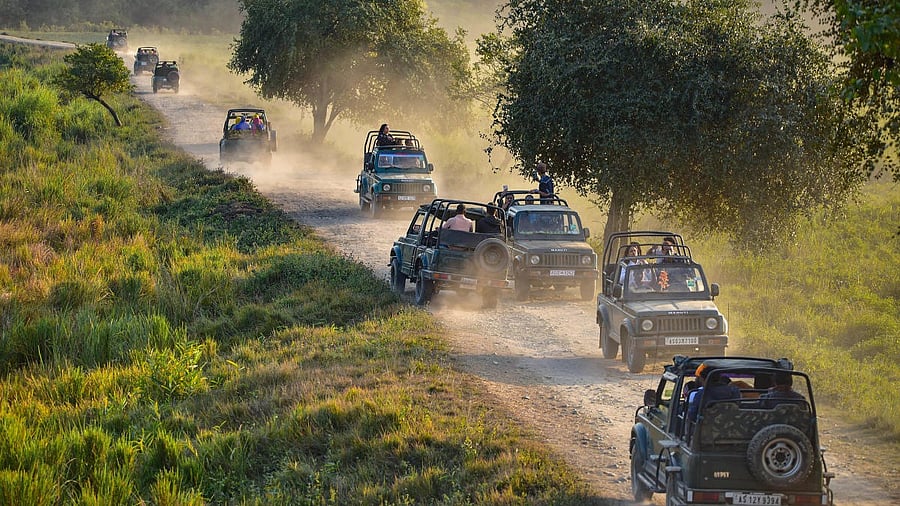
Jeep safari at Kaziranga National Park.
Credit: PTI File Photo
Guwahati: Caught in the flood that hits Assam almost every year, wildlife at the famous Kaziranga National Park and Tiger Reserve (KNPTR) rush to the adjoining Karbi Anglong hills from their inundated habitats. Many, however, are killed in vehicle hits while crossing the the 34.5km-long stretch of the NH-715 that passes through the UNESCO World Heritage Site.
A few years from now, this disturbing incidents, however, are likely to change with Prime Minister Narendra Modi on Sunday performing bhoomi pujan for infrastructure development projects worth Rs. 6,950 crores that includes construction of a 34.5km-long elevated widlife corridor along the highway passing through Kaziranga. Apart from preventing death of wildlife, the corridor, according to the government, would also reduce travel time between Assam capital Guwahati to eastern Assam towns like Dibrugarh and Jorhat.
Preventing wildlife -
The corridor, considered one of the longest continuous wildlife-friendly elevated roadways in the world, will allow wildlife to move freely beneath the road, keeping the landscape intact rather than forcing animals to use limited underpasses. This, according to conservation experts, is going to protect animals not just during floods but round the year.
According a study by Gauhati University, 6,036 wildlife of 53 species were killed in vehicle hits on the highway stretch during 2016 and 2017. The study found that 60.29 per cent (3,639) of the road kills were amphibians followed by reptiles (1,281), birds (596) and mammals (520). During the floods, hog deers bear the maximum brunt with more than 200 dying due to floods in Kaziranga and vehicle hits on the highway.
There are two important elevated wildlife corridors in India: one at Pench Tiger Reserve across Madhya Pradesh and Maharashtra and another at the adjoining Rajaji Tiger Reserve between Ganeshpur and Dehradun in Uttarakhand (20km). Kaziranga corridor, however, stands apart in terms of length, flood-driven animal movement and multi-species use.
Map of the elevated wildlife corridor at Kaziranga.
Credit: Kaziranga National Park and Tiger Reserve.
Importance of Kaziranga -
A UNESCO World Heritage Site, Kaziranga is the largest home for one-horned rhinos (2,613 as per 2022 Census). It also hosts globally significant populations of the Royal Bengal tigers, Asian elephants, water buffalo, swamp deer, beside others. Sandwiched between the Brahmaputra and the Karbi Anglong hills, 1,300-odd square kilometers, Kaziranga is one of the largest biodiversity hotspots in India. It is also one of the major attractions for tourism in India.
Enhancing connectivity -
As protection of animals became a concern during the floods, administration imposes speed restrictions on the stretch. This increases the travel time between Guwahati and eastern Assam districts like Dibrugarh, Jorhat and Tinsukia. Apart from the 35km elevated wildlife corridor, the new project comprises a 21-km bypass section and 30 km widening of the existing highway section of NH-715 from two to four lanes.
The project will pass through Nagaon, Karbi Anglong and Golaghat districts and will significantly improve connectivity. It will also enhance road safety, reduce travel time and accident rates, and support growing passenger and freight traffic. As part of the project, Bypasses will be developed at Jakhalabandha and Bokakhat that will help to decongest towns, improve urban mobility and enhance the quality of life for local residents.