
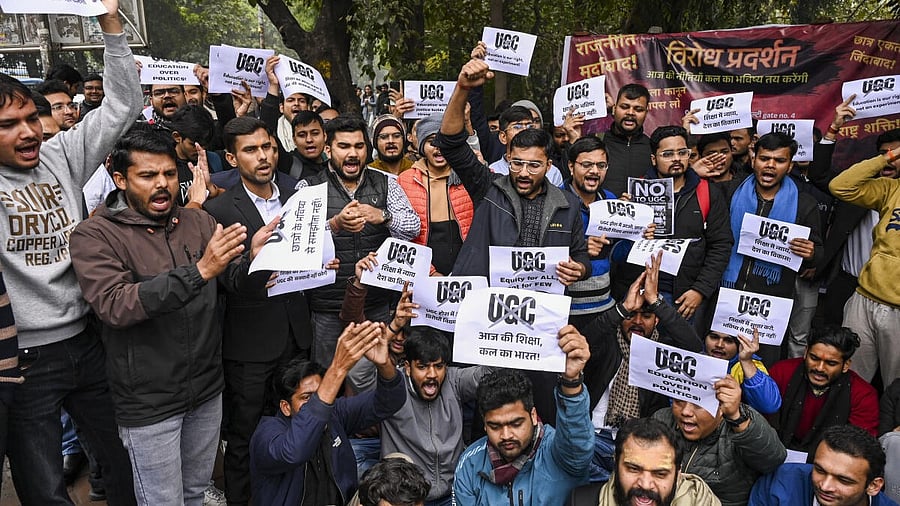
Students protest against the UGC Act at the Arts Faculty of Delhi University, in New Delhi.
Credit: PTI Photo
The Supreme Court on Thursday put on hold the operation of the UGC’s 2026 equity regulations, saying the new framework is capable of dividing society and may have a grave impact.
A bench of Chief Justice of India Surya Kant and Justice Joymalya Bagchi issued notice to the Centre and the UGC on pleas challenging validity of University Grants Commission (Promotion of Equity in Higher Education Institutions) Regulations, 2026.
The court said that the 2012 regulations will continue to operate for the time being, so that the complainants are not left remediless.
Dealing with petitions questioning exclusion of 'general category' students from complaining under its grievance redressal mechanism, the bench asked, ''In a country after 75 years, whatever we have gained in terms of developing a casteless society. Are we going regressive? What will happen?”
Raising further questions, the bench asked, ''I am finding in the measures you are taking, you are talking of separate hostels, for God’s sake, please do not do that! We have been in hostels; students have been living together. We have developed inter-caste marriages also. We should move forward towards a casteless society.”
The court opined, if it does not intervene, it will lead to a dangerous impact, and that it will divide society and also have a grave impact.
The bench agreed with the contentions of the petitioners that the 2012 regulation spoke of a more widespread and all-inclusive discrimination.
"Why should there be a regression in a protective or ameliorative legislation? The principle of non-regression evolved in environmental law. This also pervades laws, which are protective of social justice and equality. We should not go to a stage where we go to segregated schools, as in the United States, with coloured children, white boys and girls going to another school. The unity of India must be reflected in the educational institution,'' the bench said.
The court felt, this kind of situation can be exploited by mischievous elements in society.
The court issued notice returnable on March 19.
Solicitor General Tushar Mehta appeared on behalf of the Union government.
The court tagged the instant pleas with 2019 petitions.
"Meanwhile, let UGC Regulations 2026 remain in abeyance,” the bench said.
The court suggested Mehta to think of a committee of some eminent persons to look into it, so that the society can grow together and with no such differentiators.
Senior advocate Indira Jaising said the interrelationship between the definition of discrimination and caste-based discrimination requires the court’s interpretation.
"How these two interrelate with each other, and who has a remedy for grievance and what is the nature of that remedy,” she said, adding stay of the regulations was not called for at this stage.
The court clarified that it was not concerned about the general category complainants.
"We are right now concerned about the candidates who are marginalised, that their redressal system should remain in force. That is why we are saying that 2012 regulations will continue till further order,” the bench said.
The court asked the petitioners’ counsel not to make a political issue of the matter.
The main grievance of the petitioners was that the UGC adopted a non-inclusionary definition of caste-based discrimination and excluded certain categories from institutional protection. The new regulations, mandating all higher education institutions to form "equity committees" to look into discrimination complaints, were notified on January 13.
The regulations superseded (Promotion of Equity in Higher Education Institutions) Regulations, 2012. The petitions which came up for hearing before the court were filed by Rahul Dewan, Mrityunjay Tiwari and Vineet Jindal.