
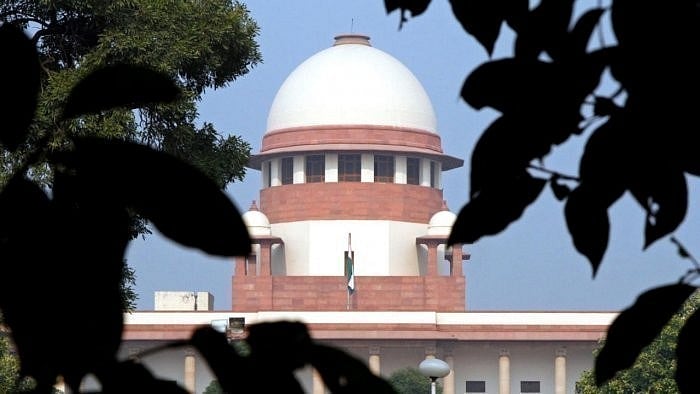
The Supreme Court of India.
Credit: PTI File Photo
New Delhi: In a message to courts, the Supreme Court on Thursday said a substantial number of service-related disputes pending across the country are aggravated by protracted and recurring litigation and the judiciary should interpret service rules in a manner that serves the very object of a selection process.
In a judgment, a bench of Justices Dipankar Datta and Augustine George Masih emphasised candidates on a reserve list cannot claim a right to appointment once the list's statutory validity has expired.
Setting aside a series of orders from the High Court on petitions filed by Rajasthan Public Service Commission, the court held that a selection process must attain finality and that reserve lists cannot be used as an "infinite stock" for appointments.
"From our combined experience on the bench, we may safely observe that a substantial number of service-related disputes pending across the country are aggravated by protracted and recurring litigation, resulting in a state of perpetual flux for many candidates across the country,'' the bench said.
The court further said, judiciary would do well to remain circumspect of these practical realities, and interpret service rules in a manner that furthers the very object of a selection process, that is, the selection of the most suitable candidates from suitable candidates for appointment in a timely manner.
The dispute was related to recruitment drives initiated by the appellant in 2019 to fill up 156 posts of junior legal officer (JLO) and assistant statistical officer (ASO) between 2013 and 2019.
The appellant was aggrieved with the directions issued for appointment of candidates from the waiting list.
Having considered the issue, the bench said, when a candidate included in a select or merit list has no indefeasible right of appointment, it would be too far-fetched to think that a candidate in the waiting or reserve list would have a better right than a candidate in the select/merit list.
"We, thus, hold that a wait-listed candidate has no right of appointment, much less an indefeasible right, except when the governing recruitment rules permit a small window authorising appointments therefrom in the specified exceptional circumstances and the appointing authority, for no good reason, denies or refuses an appointment or the reason assigned therefor is found to be arbitrary and/or discriminatory and that too, when the waiting list has not expired. What should be given primacy, therefore, is the nature and extent of right prescribed by the relevant rules,'' the bench said.
The court also pointed out, the illegality in recommending some of the candidates figuring in the reserve list could not have been made the basis for issuance of a writ of mandamus citing Article 14 of the Constitution.
In the case, the bench said, the High Court could not entertained the plea by the candidates when the reserve lists had expired due to six months time as per rules.
"Our sympathies are with the writ petitioners but the law being what it is, we hold that they may not be appointed on any of the posts for which they competed,'' the bench said.