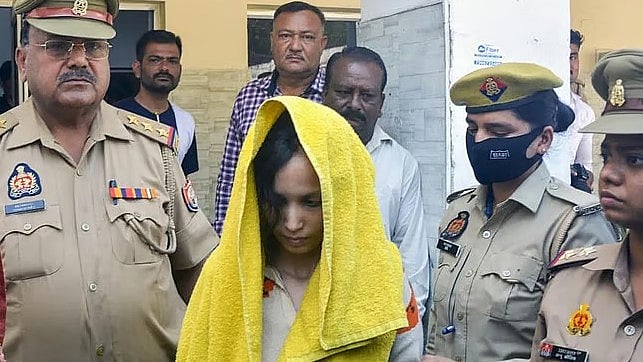
Accused, Muskan in Meerut 'blue drum' case, being arrested by the police.
Credit: PTI Photo
Lucknow: In a year when Uttar Pradesh grappled with violent crime, some of the most disturbing cases were not about strangers or organised gangs, but about families imploding from within — where trust collapsed, blood ties snapped, and relationships ended not in separation but in death.
Police records, post-mortem reports and court proceedings across districts told variations of the same story of relationships curdling into hostility and private disputes turning fatal.
One of the most chilling cases surfaced in September when police in Sambhal uncovered what they described as an "insurance mafia" operating from within a family.
It was alleged that Vishal Singhal killed his parents years apart and later his ex-wife, to claim insurance payouts exceeding Rs 50 crore. His mother's death in 2017 and his father's death in April this year were projected as road accidents and quietly closed at the time.
It was only after a woman from Meerut approached police that the pattern emerged – 64 insurance policies, staged accidents and deaths spread over eight years, all allegedly orchestrated by the son.
"The motive was money, but the betrayal was of a different order," a police officer involved in the probe said privately.
Barely months later, another horror unfolded in Jaunpur, where a retired railway employee and his wife were killed by their own son.
In Ahmadpur village, on December 8, Ambesh allegedly bludgeoned his mother to death with a pestle after a fight over money. When his father tried to intervene and alert the police, he too was killed. The bodies were dismembered and dumped in the Gomti River. For days, the accused misled family members before confessing.
If money fractured families, marriage too proved volatile.
In Varanasi, 26-year-old Aarti Pal was allegedly beaten to death by her husband just a week after their wedding in May. In another case from the city, Rahul Mishra, 30, died by suicide in December, leaving behind a video accusing his wife, her alleged lover and his mother-in-law of harassment.
Police booked the three for abetment of suicide.
Property disputes turned deadly in Ghazipur in July, when Abhay Yadav allegedly hacked his parents and sister to death after discovering that a piece of land that he thought must go to him had been transferred to his sister.
The incidents unfolded alongside a broader churn in personal relationships that repeatedly made headlines across the state — extramarital affairs ending in murder, marriages collapsing within days, and families redefining boundaries in startling ways.
In Sant Kabir Nagar, Bablu, after discovering his wife's extramarital affair, decided to marry her off to her lover. "I preferred peace over confrontation," Bablu told PTI. Referring to the headline-grabbing Meerut 'blue drum' murder, he said fear of escalating violence shaped his decision.
In Farrukhabad, Rahul separated from his wife, Vaishnavi, to help her remarry, even as the couple await a formal divorce.
In Aligarh, a woman eloped with the man her daughter was set to marry just days later, leaving the family shocked. The daughter told the media that while there were signs of frequent phone conversations, no one imagined such a turn.
Not all such cases had a pacifist ending — some left behind a trail of blood.
In Bijnor, Shivani's claim that her husband died of a heart attack collapsed after an autopsy revealed strangulation. I n Auraiya, a marriage lasted just 15 days before the woman, her lover, and a contract killer allegedly murdered her husband. Others reflected bold, if unsettling, choices.
In Budaun, Mamta, a 43-year-old mother of four, eloped with her daughter's father-in-law after a year-long affair.
In Siddharthnagar, two married villagers ran away and married each other, leaving behind their spouses and nine children.
In Amroha, a twice-married woman converted to Hinduism and married an 18-year-old schoolboy, despite having three children from previous marriages.
The Meerut 'blue drum' case cast a long shadow in public discourse.
Police alleged Muskan Rastogi and her partner murdered her husband, dismembered his body and concealed it in a cement-filled drum — a case that became a subject of a rash of memes and a shorthand for spousal brutality.
Equally disturbing was the snakebite murder case from Baghpat, where police alleged that a woman and her lover killed her husband and passed it off as death caused by a venomous snake.
Counselling psychologist Supriya Das said these were not isolated crimes but symptoms of deeper social shifts. "There is growing intolerance for emotional dissatisfaction, coupled with impulsive decisions during conflict," she said.
Police pointed out that while motives vary — greed, jealousy, suspicion or control — the common thread is the collapse of dialogue. "In many cases, there was prolonged tension. Instead of mediation or separation, people chose violence," an officer said.