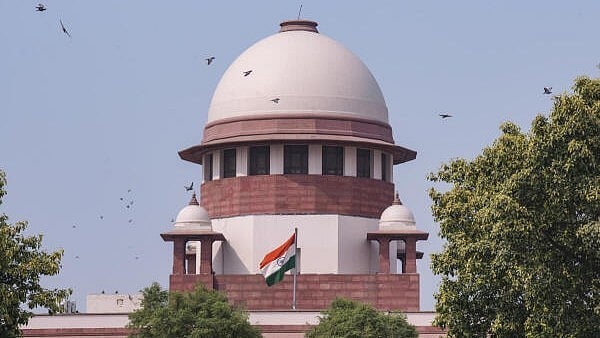
The Supreme Court of India.
Credit: PTI Photo
In deciding the bail application of the accused in the 2020 Delhi riots case, including Umar Khalid and Sharjeel Imam, the Supreme Court sought to define the application of stricter bail provisions under the Unlawful Activities (Prevention) Act, 1967, vis-a-vis the personal liberty enshrined under Article 21 of the Constitution.
The question the two-member bench of the apex court addressed is: “How is Article 21 to be applied where Parliament has expressly conditioned the grant of bail in relation to offences alleged to implicate national security?”
Section 43D(5) of the UAPA has stricter bail provisions, and bail can be denied if the court, on the perusal of the case diary, finds “there are reasonable grounds for believing that the accusations against such a person are prima facie true”.
On the application of Article 21 and the issue of prolonged incarceration, the court said the issues to be considered include whether the custody undergone is substantial and the proceedings in the case have made meaningful progress. Beyond this, the court is also required to examine whether “continued detention remains constitutionally justified”.
Laying down the “governing approach” in dealing with bail applications in UAPA cases, the court points to scrutiny of various facets, like the gravity of the offence, the role attributed to the accused, and the extent to which continued incarceration has become “demonstrably disproportionate”. Bail may be granted if the “composite evaluation” of all these factors leads to the conclusion that the detention has “crossed boundaries” of personal liberty.
But it also recognised that the threat sought to be addressed by the UAPA often materialises long before any overt act of violence is committed. Observing that criminal liability under the UAPA is not confined to the final execution of a terrorist act alone, the court said the statute defines criminality as a “process-based” concept rather than an “event-based one”.
Thus, the court granted bail to applicants except Khalid and Imam, whom the prosecution called the “alleged masterminds”.
In its interpretation of Section 43D(3) of the UAPA, the SC observed that the anti-terror statute “does not permit a collective or undifferentiated approach to bail” as it becomes necessary to distinguish between the existence of a conspiracy and the position occupied by an accused.