
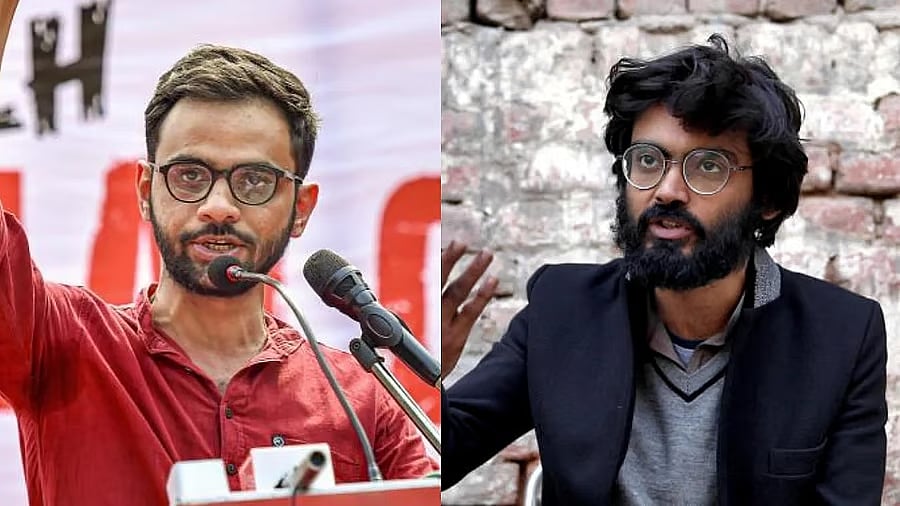
Umar Khalid (L) and Sharjeel Imam (R)
Credit: PTI Photo, Reuters Photo
New Delhi: The Supreme Court on Monday declined a plea for bail made by former JNU students Umar Khalid and Shrjeel Imam in a case lodged under the Unlawful Activities (Prevention) Act for their alleged role in the larger conspiracy related to 2020 Delhi riots, which claimed lives of 53 people and left over 700 injured.
A bench of Justices Aravind Kumar and N V Anjaria, however, allowed bail to co accused Gulfisha, Meeran Haider, Saleem Khan, Shifa, and Shadad in the case.
In case of Khalid and Imam, the bench noted that in view of the central and formative role, the statutory restriction was attracted, and court is not persuaded that their continued threshold of incarceration has crossed the threshold of Section 43D(5) of the Act.
The court, however, allowed both the accused to renew their request for bail on completion of examination of protected witnesses, and on expiry of one year period.
The bench said, the right of personal liberty was of seminal importance, and the prolonged incarceration was a matter of serious concern.
"However, the constitutional court can't ignore Section 43D(5) which represents a legislative restriction. When the prosecution material prima facie disclosed offence, statutory restriction must prevail and if not, liberty must prevail,'' the bench said.
The court found that Khalid and Imam stood on different footing and it can't be ignored in terms of parity and culpabilty, this becomes a duty of the court to examine bail pleas individually to see whether pre-trial liberty is attracted.
"Liberty is of foundational importance at the same time, constitutional does not conceive liberty in isolation. When bail is sought in special statute, the court is to undertake an exercise except restricting inquiry to the confines of law,'' the bench said.
The court noted the record disclosed that all the appellants do not stand on equal footing as regards culpability.
"The hierarchy of participation requires the court to assess each application individually,'' the bench said, asserting that Article 21 of the Constitution required the state to justify prolonged pre trial custody.
The court emphasised the continued incarceration affected the guarantee under Article 21. The right to speedy trial was recognised as an important facet of right to Article 21. The delay serves as a trigger of heightened scrutiny where gravity and statutory character, role attributed, strength of the prima facie case and extent of continued incarceration have to be considered.
It pointed out, the statutory scheme of UAPA extends culpability of preparatory parts before violence is committed.
"Section 43D(5) is a conscious departure from the regular bail statute. However, it does not exclude judicial scrutiny,'' the bench said.
The court had reserved the judgment on December 10, after hearing in detail the arguments from Solicitor General Tushar Mehta, Additional Solicitor General S V Raju for Delhi police and senior advocates Kapil Sibal, Abhishek Singhvi, Siddhartha Dave, Salman Khurshid and Sidharth Luthra for accused persons.
The accused persons have been under custody for over five years in a case in which they are facing serious allegations of committing offences under the Unlawful Activities (Prevention) Act.
The Delhi police strongly opposed the bail pleas of activist Umar, Sharjeel and others, and argued that the February 2020 riots were not something spontaneous, but an "orchestrated, pre-planned and well-designed" attack on India's sovereignty.
These accused petitioners have moved the top court, against the Delhi HC's verdict of September 2, 2025, dismissing their bail applications.
The riots took place in February 2020, following clashes over the then-proposed Citizenship Amendments Act. The riots had left 53 people dead and over 700 injured.