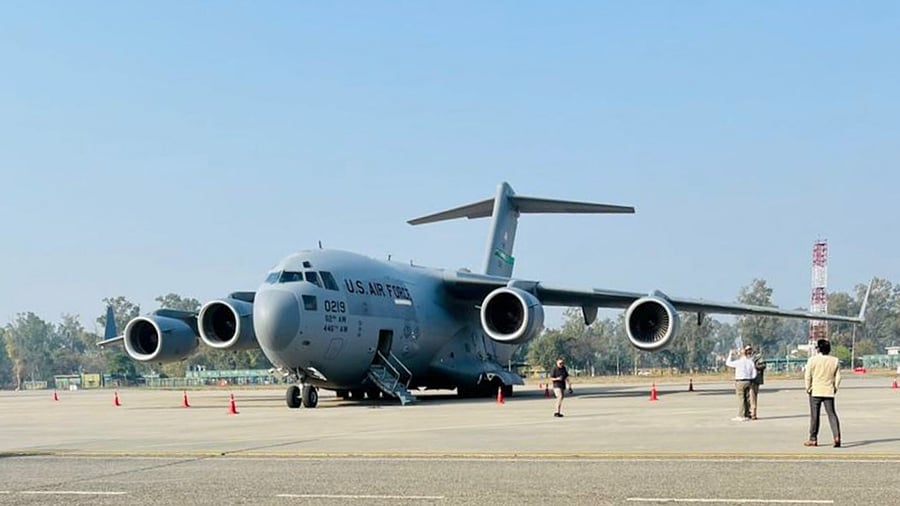
Indian migrants deported from US land at Amritsar airport
Credit: Reuters photo
The Dingucha village tragedy, in which four members of a family froze to death in January 2022 while attempting to enter the US via the Canada border, brought illegal immigration from Gujarat into sharp focus. Following the incident, the police registered FIRs against those who had arranged the travel and the Enforcement Directorate (ED) initiated a probe under the Prevention of Money Laundering Act.
Further, the deportation of 330 Indians — most of them from Punjab, Haryana and Gujarat — in January and February 2025 prompted authorities in these states to intensify action against those involved in illegal migration. FIRs were registered across Punjab and Haryana, based on which the ED also launched investigations.
In a press release dated December 19, the ED’s Jalandhar Zonal Office said search operations at 13 locations across Punjab, Haryana and Delhi in connection with the ‘dunki route case’ led to the seizure of Rs 4.68 crore in cash, gold bars worth Rs 8.07 crore, silver worth Rs 6.42 crore and several incriminating documents. During the search, 50 original passports belonging to third parties were also seized.
The ED stated that the investigation was initiated based on FIRs registered by the Punjab and Haryana police under various provisions of the Bharatiya Nyaya Sanhita (BNS), 2023, and the Immigration Act, 1983.
Investigations revealed that travel agents, middlemen, “donkers,” overseas associates, Hawala operators and those arranging lodging and logistics had a complex network.
According to the ED, migrants were sent through dangerous routes across several South American countries before illegally crossing into the US via the Mexico border. “Throughout the journey, people were tortured, extorted for additional money and forced to commit illegal acts,” the ED said.
In Gujarat, the ED began its probe based on two FIRs registered by the state police and conducted raids in Ahmedabad, Delhi, Surat, Mehsana, Nagpur and other locations in the country.
The investigation found that the accused charged Rs 60–70 lakh per individual, Rs 1–1.25 crore per couple, and Rs 50 lakh for a child. To facilitate the process, they arranged admissions in Canadian colleges and applied for student visas. However, once the individuals reached Canada, they illegally crossed into the US instead of joining the institutions, leading to the refund of college fees to the students’ accounts.
The ED identified two entities based in Mumbai and Nagpur that had agreements to secure admissions in foreign universities on a commission basis.
A police officer supervising the Dingucha case said the biggest challenge for investigators is the reluctance of victims to pursue legal cases. In the Dingucha case, relatives of the deceased did not file a complaint, forcing the state government to step in as the complainant. Subsequent investigations revealed that the victims’ brother was involved in a separate human smuggling racket.
Similarly, in a 2023 case where a family of four was kidnapped in Tehran and released after paying ransom, the victims were unwilling to pursue the matter. “I have four to five cases where victims cheated under the pretense of being sent to the US want their money back but refuse to file an FIR,” an investigating officer said.