
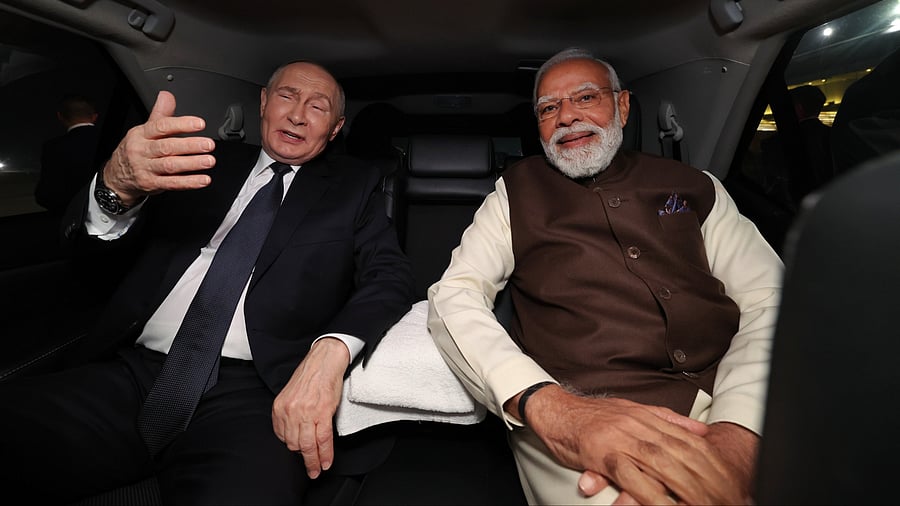
Vladimir Putin and Narendra Modi
Credit: X/@narendramodi
New Delhi: Prime Minister Narendra Modi received President Vladimir Putin at the airport in New Delhi on Thursday, making a rare departure from protocol to signal continuity in the special and privileged strategic partnership between their nations, despite United States President Donald Trump’s claims of success in persuading India to slash its oil imports from Russia.
Notwithstanding the West’s frowns over New Delhi’s ties with Moscow, Modi and Putin will on Friday hold the 23rd India-Russia annual summit and finalise a roadmap to boost the bilateral economic cooperation by 2030, apart from witnessing the signing of several other agreements.
Modi hugged Putin at the tarmac of the Indira Gandhi International Airport in New Delhi as the Russian President disembarked from his aircraft, commencing a two-day visit to India – the first after he ordered the launch of the ‘special military operations’ in Ukraine in February 2022. The two leaders rode the same vehicle to leave the airport, just as they had done while attending the summit of the Shanghai Cooperation Organisation at Tianjin in China a couple of months back.
“Delighted to welcome my friend, President Putin, to India. Looking forward to our interactions later this evening and tomorrow,” Modi wrote, posting pictures of him with Putin on X. “India-Russia friendship is a time-tested one that has greatly benefitted our people.”
“Our relationship extends beyond mere diplomacy; it’s also personal,” Putin said, speaking about his rapport with Modi during an interview with a TV channel.
The Prime Minister later hosted a dinner for the Russian President at his residence on the Lok Kalyan Marg. The tête-à-tête between the two leaders during the ride from the airport and during the dinner set the stage for the formal talks during the annual summit on Friday, when the two sides would sign an agreement to streamline the legal mobility of skilled and semi-skilled people from India to Russia. The agreements to boost trade and economic relations, as well as cooperation in healthcare and media, would be inked too.
They will discuss Russia’s proposal for the sale of SU-57E fighter jets and additional S-400 missiles to India, in addition to reviewing the bilateral defence cooperation. The India-Russia cooperation in space technology and nuclear energy will also be on the agenda.
Putin is likely to share with Modi his views on the 28-point peace plan Trump has put forward to halt the Russia-Ukraine conflict. He had a long meeting with Trump’s envoys – Steve Witkoff and Jared Kushner – in Moscow earlier this week, but the talks did not result in a breakthrough. Witkoff and Kushner will soon hold a meeting with a senior aide of Ukrainian President Volodymyr Zelenskyy in Miami.
India has been conveying to Russia its concerns over the trade deficit widening from $6.6 billion to $58.9 billion, along with a five-fold rise in bilateral trade in goods from $13 billion in 2021 to $68 billion in 2024-25, well on course to reach $100 billion by 2030 – a target set by Modi and Putin earlier, despite the sanctions imposed by the US and the European Union on the former Soviet Union nation, to restrict its business with other nations, in response to its military aggression against Ukraine.
The Modi-Putin summit will explore ways to expand India’s exports to Russia, particularly in sectors like pharmaceuticals, agricultural produce, processed food products, and consumer products. India is also keen to increase fertiliser imports from Russia.
Putin acknowledged that Moscow and New Delhi were facing certain difficulties, but were developing ways to overcome them, in particular, using technological solutions, such as “the existing system for exchanging financial electronic information of the Bank of Russia”, Tass reported, quoting Putin telling an Indian TV channel. “Over 90 per cent of our payments are already made in national currencies.”
Trump had on August 6 announced an additional 25 per cent tariff – on top of the 25 per cent levied earlier – on India’s exports to the US, in a move to dissuade the South Asian nation from buying oil from Russia. He and his aides had accused India of funding Putin’s war in Ukraine by continuing to buy oil from Russia, defying the sanctions the US and the European Union had imposed on the former Soviet Union nation.
Russia’s share in India’s total crude oil imports rose from less than 2 per cent before the launch of its war in Ukraine in 2022 to around 40 per cent by 2023–24. But imports from Russia came down from over 2 million barrels per day in June 2025 to 1.6 million barrels per day in September 2025. The imports saw a rebound in October and the first half of November, but fell by nearly 30 per cent after the stringent US sanctions on Rosneft and Lukoil of Russia came into effect on November 21.
Trump has been claiming over the past several weeks that he could persuade India to slash its oil imports from Russia.
New Delhi never officially acknowledged the role of the US sanctions in the decline of India’s imports of oil from Russia, but underlined that its energy import policies included broad-basing and diversifying sources in accordance with market conditions and guided by the objective of safeguarding the interests of consumers in the country.