
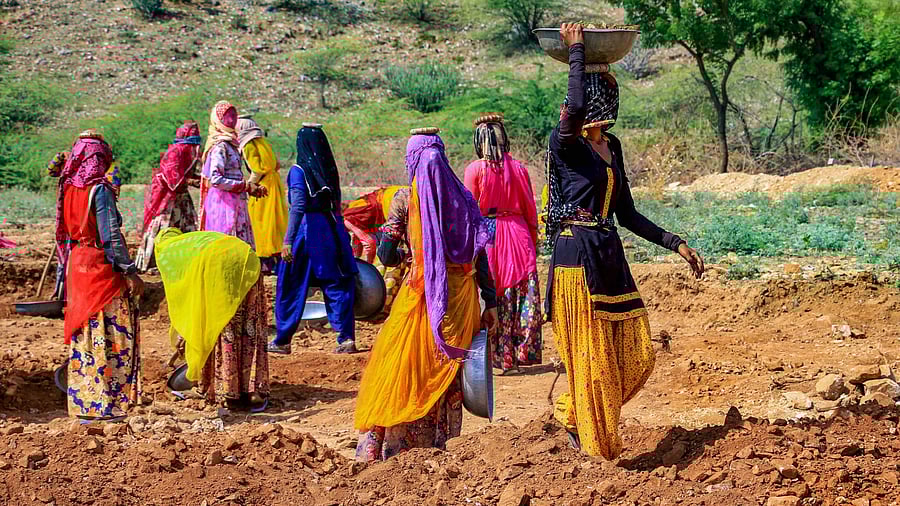
Women working at a site under the Mahatma Gandhi National Rural Employment Guarantee Act scheme on the outskirts of Ajmer in Rajasthan.
Credit: PTI File Photo
Union Minister of Rural Development and Agriculture and Farmers’ Welfare Shivraj Singh Chouhan introduced the Viksit Bharat - Guarantee for Rozgar and Ajeevika Mission (Gramin) Bill, 2025, (VB-G RAM G) in the Lok Sabha on December 16.
The Bill, which will replace the Mahatma Gandhi National Rural Employment Guarantee Act (MGNREGA) of 2005, seeks to provide a statutory guarantee of 125 days of wage employment in a financial year to every rural household whose adult members volunteer to undertake unskilled manual work.
The Opposition, led by the Congress, is up in arms against the government for "removal" of Mahatma Gandhi's name and for introducing the bill without sending it to Parliamentary Standing Committee for scrutiny.
Several Opposition MPs protested in the Parliament House complex on Tuesday, accusing BJP-led NDA dispensation of "insulting" Mahatma Gandhi.
MGNREGA was the flagship programme of the erstwhile UPA government led by the Congress.
While the BJP and Prime Minister Narendra Modi had criticised the MGNREGA, the Modi government retained the scheme and had acknowledged that it provided wage support to rural households in the last two decades.
In a statement, the Rural Development Ministry said the proposed legislation would establish a modern statutory framework aligned with the goal of 'Viksit Bharat 2047'.
It said the Bill aims to create both employment and durable rural infrastructure through four priority verticals — water security through water-related works, core rural infrastructure, livelihood-related infrastructure, and special works to mitigate extreme weather events.
The Ministry called the proposed scheme a "major upgrade" over the MGNREGA, fixing "structural weaknesses" while enhancing employment, transparency, planning, and accountability. It also said digital attendance, digital payments and data-driven planning would increase efficiency.
While the MGNREGA scheme was demand driven, with the Union government bound to allocate more money if demand for work was there, under the proposed scheme, the Centre will determine State-wise normative allocation for each financial year. Any expenditure incurred by a State in excess would be borne by the state government.
The MGNREGA scheme wages were 100 per cent funded by the Centre, while material cost was shared between the Centre and and the States in the ratio of 75:25.
Under the proposed scheme, the financial liability will be shared between the Centre and the State governments. It will be 90:10 for the Northeastern States and Himalayan States, and 60:40 for all other States and Union Territories (UTs) with legislature. For the UTs without a legislature, the whole cost will be borne by the Centre, according to the Ministry.