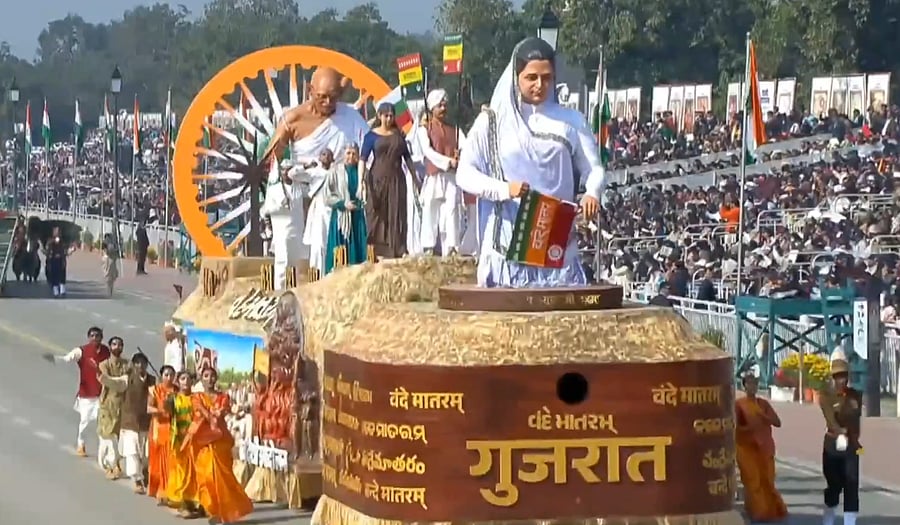
Gujarat's tableau rolled down the Kartavya Path.
Credit: X/@ChaudhryShankar
New Delhi: The colourful Republic Day tableau of Gujarat commemorates 150 years of 'Vande Mataram', and pays tribute to Bhikhaji Cama, who carried India's message of freedom to foreign soil.
The float rolled down the Kartavya Path on Monday to an enthusiastic cheer from the crowds.
The tableau depicts Cama holding a flag inscribed with 'Vande Mataram', which was first unfurled in Paris in 1907 and later presented at the Indian Socialist Conference in Germany's Stuttgart, Germany, representing India's revolutionary voice abroad.
The float also portrays the legacy of the tricolour from the one prepared by Cama to its current form that was adopted by the Constituent Assembly ahead of Independence.
Cama, who was born in Gujarat's Navsari, is depicted on the front side of the state's float.
The tableau is designed on the state subject of 'Mantra of Swadeshi - Self-Reliance - Freedom: Vande Mataram'.
"Vande Mataram is the timeless mantra that awakened the spirit of Swadeshi, self-reliance, and freedom in India's national consciousness," according to a description of the float in the official parade booklet.
Marking the 150th anniversary of 'Vande Mataram', the tableau pays tribute to Madam Bhikhaji Cama of Navsari, Gujarat, who, along with revolutionaries Shyamji Krishna Varma and Sardar Singh Rana, carried India's message of freedom to foreign soil, it adds.
Her Vande Mataram flag, first unfurled in Paris in 1907 and later presented at the Indian Socialist Conference in Stuttgart, stands as a symbol of India's revolutionary voice abroad, the description reads.
This legacy is harmoniously linked with Mahatma Gandhi's propagation of Swadeshi through the charkha and its relevance to the vision of Aatmanirbhar Bharat.
At the front of the tableau, Cama is depicted holding her self-designed flag with the slogan inscribed below in multiple Indian languages recognised by the Constitution.
The central section traces key milestones in the evolution of the national flag-from the Swadeshi movement at Parsi Bagan, Calcutta (now Kolkata) in 1906, to the Home Rule flag of 1917, Pingali Venkayya design presented to Mahatma Gandhi in 1921, its near adoption in 1931, and finally the acceptance of the tricolour with the Dharma Chakra by the Constituent Assembly on July 22, 1947, it says.
The tableau's rear side features a sculpture of Mahatma Gandhi, symbolising freedom through Swadeshi and the charkha, set against a grand Dharma Chakra.
Folk artistes performing to 'Kasumbi No Rang', composed by Gujarati poet Zaverchand Meghani, infused the tableau with patriotic fervour, honouring the sacrifices that shaped India's freedom and continue to inspire a self-reliant nation today.