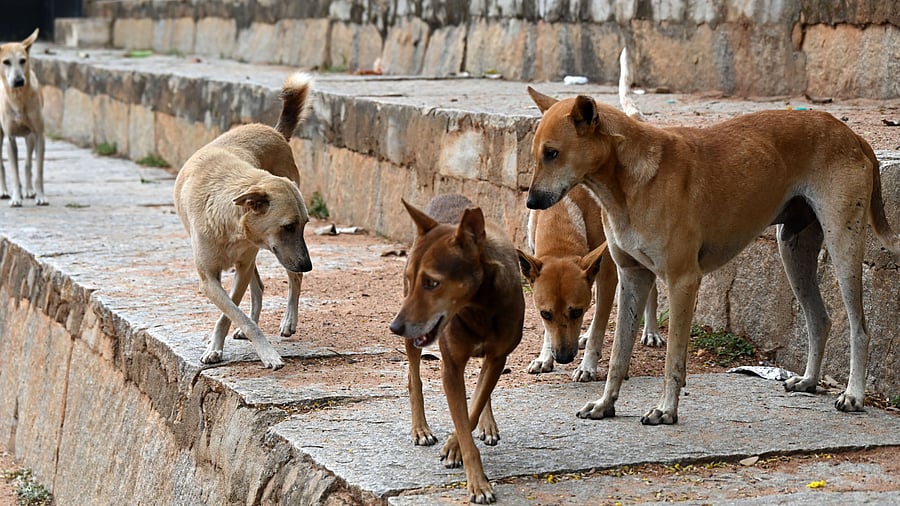
Unpacking the dispute around Gujarat's stray dog mandate.
Credit: DH PHOTO/B K JANARDHAN
Over 10,000 Talatis-cum-Mantris (village-level administrative officers) in Gujarat are reportedly on edge over a state government directive requiring them to catch stray dogs within their respective jurisdictions, sterilise them, and send them to shelter homes.
The government issued the order following the Supreme Court ruling directing states to take action to curb the stray dog menace. The government order has sparked controversy, with an organisation representing Talatis writing to the state government, calling the new responsibility both “insulting” and “impractical”.
On November 7, the Supreme Court, while hearing a suo motu public interest litigation, directed all states to take measures to address the stray dog problem. In response to this directive, the Gujarat government’s rural development department issued a notification on November 18. The notification mandated that “Talatis monitor and control the presence of stray dogs, preventing them from entering government offices, educational institutions, hospitals, and other public places.”
The Talatis argue that the directive places an “unreasonable burden” on them, given their existing responsibilities and lack of resources to carry out such skilled tasks. The Gujarat Rajya Talati-Mantri Mahamandal, the representative body of the Talatis, has written to the government protesting the decision and demanding to revoke it.
“In this regard, we would like to submit that the Talati-cum-Mantri, along with the work related to Gram Panchayat administration, is already handling a wide range of responsibilities, including revenue-related work, disaster management, registration of births and deaths, marriage registration, implementation of various welfare schemes, collection of panchayat taxes, and also assisting BLOs in the ongoing Election Commission of India’s Special Intensive Revision (SIR) of voters’ list. They are already under immense workload and pressure,” the Mahamandal said in the letter submitted to the government last week.
The notification states that at the district level, the pashu niyamak adhikari (animal husbandry officer) and pashu chikitsak (veterinarian) at the taluka level have been appointed as nodal officers for this task. However, at the village level, there is no designated staff or department created by the government to handle such responsibilities. Instead, the work has been assigned to the Talatis.
“Despite the fact that Talatis are not trained for these specialised tasks, they have been assigned this responsibility, which does not seem appropriate,” the Mahamandal has claimed.
The notification states that designated officials, including Talatis, must ensure that stray dogs do not enter any government or private educational institutes, hospitals, or other public places. Information about the nodal officers must be posted at the entrance of government premises.
“The jurisdictional authority of the local self-government institution will be responsible for immediately removing any stray dogs found within the institution’s premises and, as per the Animal Birth Control Rules, 2023, ensuring proper sterilisation and vaccination, after which the animals will be sent to the designated shelter,” states the notification.
“The government has not responded to our demand to take the notification back as of today. We met with several ministers, including Rushikesh Patel, earlier this week, but all we received were verbal assurances. Let me be very clear – Talatis are not going to follow these instructions,” Pankaj Modi, the president of the Talati Mahamandal, told DH.
Modi said that there are just over 10,000 Talatis, also known as patvaris in many parts of India, working across 14,300 Gram Panchayats in the state. Modi added that Talatis are already burdened with a heavy workload, and such a notification only adds extra pressure, especially for tasks they are not trained to handle.
According to figures presented in the Lok Sabha in 2023, Gujarat, with nearly 1.69 lakh cases of dog bites, was among the top five states in the country. In the past few years, cases of dogs mauling children to death have hit headlines from various places in Surat and Rajkot. A police inspector recently died of rabies.
During the hearing in the apex court, the Union government, citing newspaper reports, stated that “approximately 37,15,713 dog bites occurred in India in 2024, and in several cases, human lives were lost due to trauma and rabies infection.” The Gujarat government filed an affidavit in the court stating that a total of 13 Animal Birth Control Centres (shelters/pounds) were functional in the state, which were established by Urban Local Bodies “for carrying out the capture, sterilisation, deworming, vaccination, and post-operative care of stray dogs.”
It said that the state undertook sustained sterilisation and immunisation drives across all major ULBs. “Between January 1, 2024, and October 10, 2025, a total of 96,787 stray dogs have been sterilised, and 1,26,746 stray dogs have been immunised under the supervision of qualified veterinarians and trained staff,” the affidavit claimed.
The affidavit says that each of the 13 operational ABC centres is manned by 21 veterinary surgeons and 110 trained dog-catching personnel, and 26 specially designed vehicles fitted with safety cages have been deployed across ULBs.