
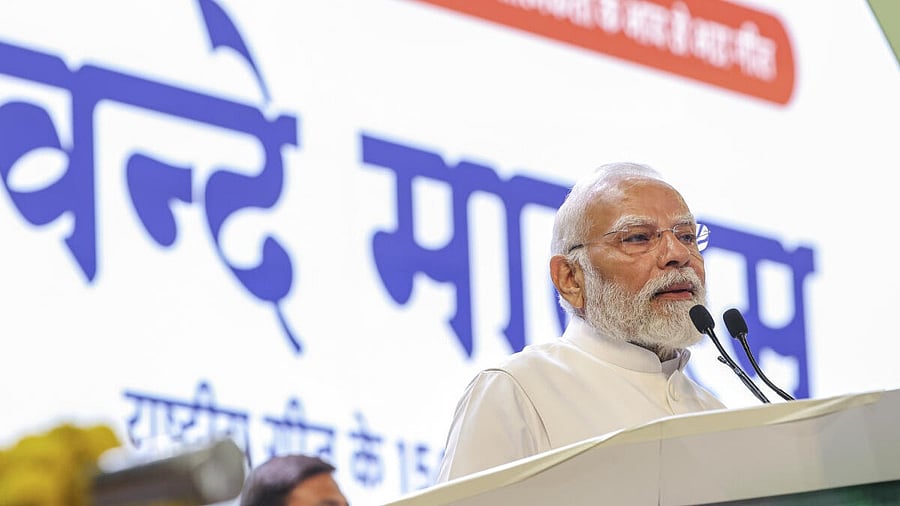
In this image released on Nov. 7, 2025, Prime Minister Narendra Modi addresses an event marking 150 years of the national song ‘Vande Mataram’, at the Indira Gandhi Indoor (IGI) Stadium, in New Delhi.
Credit: PMO via PTI Photo
New Delhi: Prime minister Narendra Modi on Friday said that the Congress due to its “divisive mindset” dropped stanzas from the Vande Mataram which eventually “sowed the seeds” of Partition.
At an event held to commemorate 150 years of the national song, PM Modi said that the omissions became “a part of its soul.”
During the event, PM Modi also released a commemorative stamp and coin and described Vande Mataram as “a word, a mantra, an energy, a dream, a resolve.”
“Vande Mataram became the voice of India’s freedom struggle, it expressed the feelings of every Indian. But, unfortunately, in 1937, important stanzas of Vande Mataram… a part of its soul, were severed. The division of Vande Mataram also sowed the seeds of partition,” Modi said.
He said the younger generation should know about it. “Younger people should know why this injustice was done with this ‘maha mantra’ of nation-building… this divisive mindset is still a challenge for the country,” he said.
“Vande Mataram is a true symbol of India’s unity as it has inspired generations. As we mark 150 years of Vande Mataram, this will give us new inspiration and fill the people of the country with new energy,” PM Modi said.
The original poem by Bankim Chandra Chatterjee, from which the national song was adapted, included six stanzas, with the later verses referencing Hindu goddesses such as Durga and Lakshmi. In 1937, the Indian National Congress, at its Faizabad session, adopted only the first two stanzas of the poem for public use.
The poem, first published in the literary journal Bangadarshan and later in the novel Anandamath, was adopted by the Constituent Assembly on January 24, 1950 as the national song of India. The 150-year celebration is set to run from November 7, 2025 to November 7, 2026 and is intended to reignite the song’s original revolutionary spirit among the youth and the nation at large.