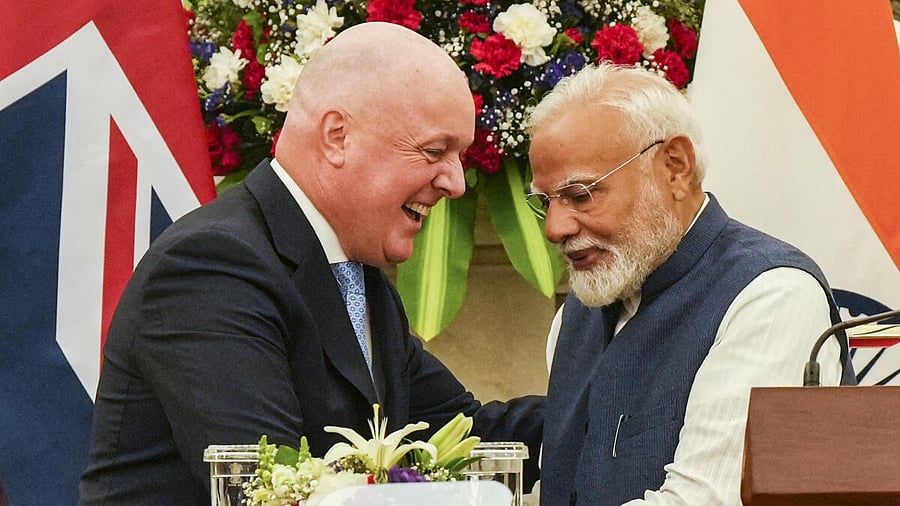
Prime Minister Narendra Modi and New Zealand's Prime Minister Christopher Luxon.
Credit: PTI
New Delhi: India and New Zealand on Monday announced a free trade deal that will eliminate duty on a majority of goods trade (except dairy and farm products), ease mobility rules for students and professionals and facilitate investments.
The deal was clinched in around nine months after launching the negotiations, making it the fastest Free Trade Agreement (FTA) pocketed by India.
Following the US imposition of a steep 50% tariffs, Prime Minister Narendra Modi’s government seems to be showing great urgency on FTAs, signing two such deals — with Oman and the United Kingdom — just this year.
Under the FTA, New Zealand has agreed to provide duty-free access to all Indian exports. On the other hand, India has offered to eliminate tariffs on 70% of goods covering 95% of the trade value. However, India has excluded its dairy sector and select farm products from the agreement.
“We have been very sensitive to protect all the sectors, like farmers’ interest in rice, wheat, dairy, soya and various other farmer products, agricultural products, which have not been opened up with any access,” Commerce and Industry Minister Piyush Goyal told reporters.
Dairy and farm products have been among the most sensitive and politically charged areas in most trade negotiations. New Zealand, which is among the world’s largest exporters of dairy products, has been pressing for greater access to the Indian market in this sector.
It also remains a key point of contention in the ongoing India-US trade deal negotiations. India and the United States had launched talks for a bilateral trade agreement in March with a target to conclude the first tranche of the deal by September-October. Goyal claimed that the trade deal with the US is in the advanced stage of discussion.
India-New Zealand deal is likely to be signed in the next three months and would be implemented in 2026.
The two countries announced the conclusion of the deal after Modi held a telephonic conversation with New Zealand’s Prime Minister Christopher Luxon.
“The two leaders jointly announced the successful conclusion of the historic, ambitious and mutually beneficial India–New Zealand Free Trade Agreement (FTA),” the Prime Minister’s Office said in a statement.
The FTA negotiation was launched during Luxon’s visit to New Delhi in March this year.
“This is an incredibly exciting opportunity for New Zealand exporters, with tariffs immediately removed on more than half of New Zealand’s current exports
to India from day one. The gains are wide-ranging and significant,” Luxon said in a statement.
Apart from offering 100% duty free access to Indian goods, New Zealand has agreed to facilitate $20 billion investments in India over the next 15 years. New Zealand has also agreed to ease mobility rules for Indian students and professionals.
There will be no numerical cap on Indian student visas. The Indian students will also be allowed to work
for up to 20 hours a week during their studies in New Zealand.
Goyal said bilateral trade between India and New Zealand is likely to double to $5 billion in the next five years. India-New Zealand total trade, goods and
services put together, stood at $2.4 billion in 2024-25; merchandise trade stood at $1.3 billion.
“The agreement unlocks new opportunities for India’s services sector across IT & ITeS, finance, education, tourism, construction and other areas,” said S C Ralhan,
President, Federation of Indian Export Organisations (FIEO).
Enhanced mobility provisions, including working holiday visas, post-study work pathways and a dedicated quota of 5,000 temporary employment visas for skilled Indian professionals, will further facilitate global career opportunities for Indian talent, Ralhan added.
Apart from tariff liberalisation, the FTA includes provisions to address non-tariff barriers through enhanced regulatory cooperation, transparency, and streamlined customs, sanitary and phyto-sanitary (SPS) measures and technical barriers to trade disciplines, as per a statement by the commerce ministry.