
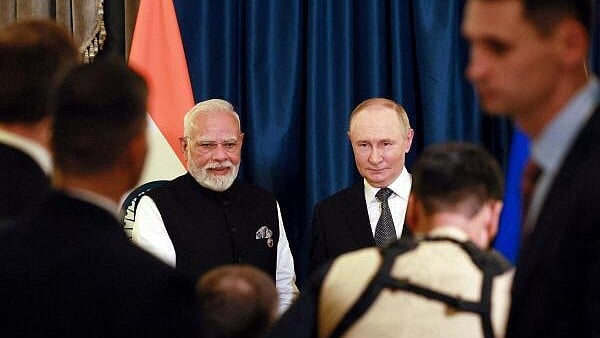
Russian President Vladimir Putin and Indian Prime Minister Narendra Modi.
Credit: Reuters Photo
New Delhi: Though India’s oil imports from Russia may decline for “a brief period”, no external interference will be allowed to stymie the growth of bilateral commerce, the Kremlin stated on Tuesday, confirming that President Vladimir Putin will discuss the sale of SU-57E fighter jets and additional S-400 missiles with Prime Minister Narendra Modi this week.
The Modi-Putin meeting on Friday will see New Delhi and Moscow signing an agreement to streamline the legal mobility of skilled and semi-skilled people from India to Russia. The agreements to boost trade and economic relations, as well as cooperation in healthcare and media, are likely to be inked too.
“There can be, for a very brief period of time, insignificant decreases in the volume of oil trade (from Russia to India),” Putin’s spokesperson Dmitry Peskov said on Tuesday. He was replying to queries from journalists in New Delhi during an online media briefing ahead of Putin’s visit to meet Modi for the 23rd annual India-Russia summit.
“We’re looking forward to possibilities despite everything to ensure our right to sell oil and to ensure the right of those who want to purchase oil to ensure the right to buy our oil. We are working on creating a necessary environment for ensuring these rights.”
Peskov said that Russia was ready to work with India to narrow the imbalance in bilateral trade.
India has been conveying its concerns over the trade deficit widening from Rs 59,361 crore ($6.6 billion) to Rs 5,29,751 crore ($58.9 billion), along with a five-fold rise in bilateral trade in goods from Rs 1,16,923 crore ($13 billion) in 2021 to Rs 6,11,550 crore ($68 billion) in 2024-25, well on course to reach Rs 8,99,338 crore ($100 billion) by 2030 – a target set by Modi and Putin earlier.
A source in New Delhi said that the Modi-Putin summit would explore ways to expand India’s exports to Russia, particularly in sectors like pharmaceuticals, agricultural produce, processed food products, and consumer products. India is also keen to increase fertiliser imports from Russia, added the source.
President Donald Trump of the United States has been claiming over the past several weeks that he could persuade India to slash its oil imports from Russia.
Trump had announced on August 6 an additional 25 per cent tariff – on top of the 25 per cent levied earlier – on India’s exports to the US, in a move to dissuade the South Asian nation from buying oil from Russia.
He and his aides had accused India of funding Putin’s war in Ukraine by continuing to buy oil from Russia, defying the sanctions the US and the European Union had imposed on the former Soviet Union nation.
“We understand that there is pressure, that pressure is being exerted on India. And, therefore, we should be very careful in shaping the architecture of our relations, making sure they’re free from any influence of third countries," Peskov told journalists in New Delhi on Tuesday. "We must protect our relations. We must protect our trade (from external interference)”.
Russia’s share in India’s total crude oil imports rose from less than 2 per cent before the launch of its war in Ukraine in 2022 to around 40 per cent by 2023–24. But imports from Russia came down from over 2 million barrels per day in June 2025 to 1.6 million barrels per day in September 2025.
The imports saw a rebound in October and the first half of November, but fell by nearly 30 per cent after the stringent US sanctions on Rosneft and Lukoil of Russia came into effect on November 21.
“We have deep experience in performing under the illegal sanction regimes,” Peskov said, adding, “We have our own technologies in doing that. We will continue to make those technologies more sophisticated should this practice of sanctions continue.”
New Delhi never officially acknowledged the role of the US sanctions in the decline of India’s imports of oil from Russia, but underlined that its energy import policies included broad-basing and diversifying sources in accordance with market conditions and guided by the objective of safeguarding the interests of consumers in the country.
Peskov said that Russia’s proposal for the sale of the SU-57E fifth-generation stealth fighter jets and additional S-400 Triumf missiles to boost the air defence of India would be on the agenda of the Modi-Putin summit.
“As far as our cooperation in the defence industry goes, let's remember the famous Brahmos missiles. It's not only production, or it's not only acts of buying or selling, but it's the exchange of high technologies, and it really paves the way for a bright future in this field of cooperation. We're developing quite a variety of very complicated systems,” said the spokesperson of the Kremlin.
The source in New Delhi, however, said that although Modi and Putin would discuss bilateral defence cooperation, no new deal for India to purchase military hardware from Russia would be announced during the summit.