
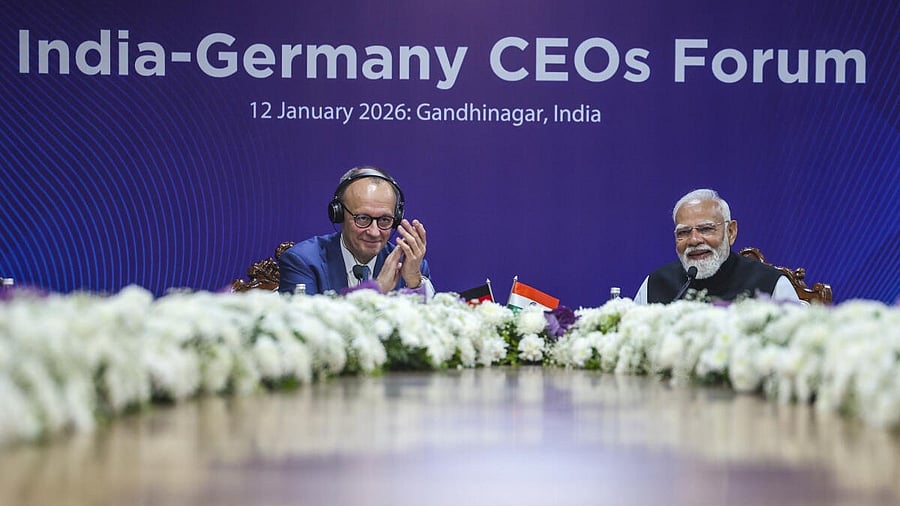
In this image received on Jan. 12, 2026, Prime Minister Narendra Modi and German Chancellor Friedrich Merz during the India-Germany CEOs Forum at Mahatma Mandir Convention Centre, in Gandhinagar, Gujarat.
Credit: PMO via PTI Photo
New Delhi: India’s negotiations with Germany to buy six conventional submarines for the Indian Navy is “proceeding positively”, but the deal has not been concluded yet, a top official said on Monday even as Berlin sought “deeper cooperation” between the defence industries of the two nations.
With defence and security issues being a key item on the agenda of the summit meeting between Prime Minister Narendra Modi and German Chancellor Friedrich Merz in Ahmedabad, the two countries signed a declaration of intent on strengthening the bilateral defence industrial cooperation.
Chancellor Merz said Germany wanted a closer security partnership with New Delhi, including deeper "cooperation between our defence industries" to cut India's traditional dependence on Russia for military hardware.
“We will work on a roadmap to enhance cooperation between our defence industries, which will open up new opportunities for co-development and co-production,” said Modi.
Merz began his two-day India visit -- his first to Asia since taking office in May -- two weeks ahead of an EU-India summit and as India and the European bloc are working on a free trade agreement.
Asked about the long awaited submarine deal in a post-summit media briefing, Foreign Secretary Vikram Misri said, “There are technical, financial and commercial discussions in such deals. These discussions have maintained a positive momentum. The deal has not been concluded, but discussions are proceeding positively and we hope to see a positive outcome.”
New Delhi has been negotiating with Berlin to procure six diesel-electric submarines with air independent propulsion technology from German major ThyssenKrupp Marine Systems. The underwater boats will be manufactured by the Mazagaon Dock Ltd in Mumbai.
The two leaders took note of the continuing cooperation in submarines, obstacle avoidance system for helicopters and Counter Unmanned Aerial Systems, said the joint statement issued after the summit meeting.
They looked forward to enhanced defence industrial collaboration relying on skilled workforce and competitive costs from India and high technologies and investment from Germany.
Misri said Germany modified its defence policies to favour India as earlier it was difficult for arms manufacturers to obtain export licenses and the process was time consuming.
But the situation has changed and clearances are coming fast. “Almost the entire backlog has been cleared,” he said.
The Foreign Secretary asserted that India’s sourcing of military hardware from multiple countries was “entirely driven by national interest.”
“There are a lot of factors involved and it is certainly not ideological. It is entirely driven by our interest. I would not say that sourcing from one is linked to sourcing from another," Misri said responding to a query on German Chancellor’s comments on Russian supply of defence equipment.
According to Stockholm International Peace Research Institute’s March 2025 data sheet, Berlin is among the world’s top five exporters of arms, but the top three recipients of German arms are Ukraine, Egypt and Israel.