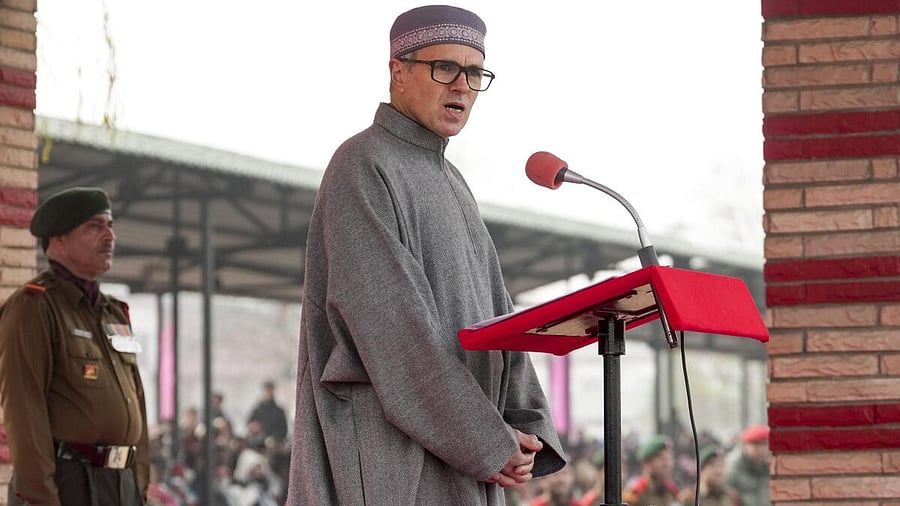
Jammu and Kashmir Chief Minister Omar Abdullah.
Credit: PTI Photo
Srinagar: Jammu and Kashmir Chief Minister Omar Abdullah appears to be recalibrating his strategy with New Delhi.
After spending his first year in office pressing relentlessly—but unsuccessfully—for the restoration of statehood, he is now invoking the year’s security setbacks to argue that the Union Territory (UT) governance model has “completely failed” Kashmir’s needs.
His remarks at the Hindustan Times Leadership Summit 2025 indicate a deliberate shift: if political persuasion has not worked, framing statehood as a security necessity might.
Speaking in New Delhi, Omar said plainly that the UT structure “is not suitable for Jammu and Kashmir,” insisting that governance and security “cannot operate in silos.” Pointing to a series of high-impact attacks this year—the April Baisaran strike in Pahalgam to the November 10 car blast at Delhi’s Red Fort allegedly linked to a conspiracy hatched in J&K—he described 2025 as “a difficult one from the security paradigm.”
He did not connect these attacks operationally, but referred to them collectively to underline his core argument: an elected government cannot be distanced from security decisions.
“You cannot have an elected government that is completely removed from security-related decisions,” he said, arguing that the UT model has weakened coordination between civilian officials and security agencies.
This marks a shift from Omar’s earlier rhetoric. Soon after taking office in 2024, he asserted that restoring statehood would “resolve most of J&K’s problems.” Even a year later, he continued to express confidence.
But on October 28, 2025, for the first time since assuming office, he acknowledged that his optimism about New Delhi’s intent was fading. With the Centre refusing to commit to timelines, his tone has hardened—and widened to include a critique of the UT’s institutional shortcomings.
Political analyst Prof. Gul Mohammad Wani sees Omar’s shift as calculated rather than reactive. “By foregrounding security lapses, Omar Abdullah is trying to convert a political demand into a national-security argument,” Wani told DH.
“He (Omar) is telling New Delhi that stability in Kashmir cannot be ensured through bureaucratic centralisation. The real issue he is flagging is the need for political accountability in security management,” he added.
Omar’s assertion that “home-grown terrorism never really went away” also challenges the Centre’s narrative that militancy has been structurally dismantled since the abrogation of Article 370. By pointing to both local recruits and plots with national reach, he is arguing that bureaucratic governance cannot effectively navigate a layered threat environment.
For the Chief Minister, the stakes are dual. Politically, he leads a coalition that must continually defend its relevance in a post-370 system that has diluted the authority of the elected executive. Strategically, reframing statehood restoration as essential for better security coordination allows him to occupy a centrist, governance-first space distinct from both separatist nostalgia and pro-BJP centralism.
But the risks are evident. New Delhi has consistently showcased improved security as validation of its Kashmir policy; any challenge to that narrative may trigger harsh political pushback. Security agencies, too, often bristle when political leaders interpret operational events through governance critiques.
Yet Omar’s recalibration is unmistakable. If constitutional restoration cannot be delivered on democratic or federal grounds, he is positioning it as indispensable for an effective security architecture. In a year marked by renewed militancy in the Valley and a major attack in the national capital, it is an argument the Centre cannot easily dismiss.
Whether Delhi views it as a constructive warning or a political gambit remains unclear. But Omar Abdullah has shifted the battlefield: the demand for statehood is now framed not merely as a question of political rights, but of national security—Delhi’s most sensitive domain.