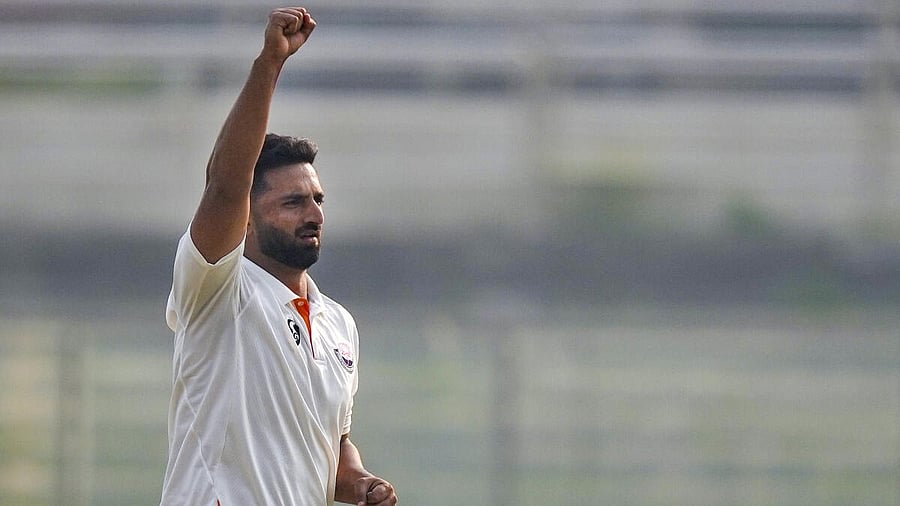
A file photo of Auqib Nabi Dar, who was bought by Delhi Capitals for Rs 8.4 crore at IPL players' auction in Abu Dhabi.
Credit: PTI Photo
Srinagar: On a quiet street in Sheeri village of north Kashmir’s Baramulla, where childhoods were once shaped as much by uncertainty as by ambition, Auqib Nabi’s journey to the Indian Premier League (IPL) feels almost improbable.
Today, his ₹8.4-crore IPL jackpot carries a meaning far beyond personal success, reflecting how aspirations among Kashmiri youth are expanding as violence recedes and opportunities widen.
Born on November 4, 1996, in Sheeri, Nabi grew up during years when conflict routinely disrupted daily life. Curfews, shutdowns and long spells of tension often stalled sporting activity, pushing many families to prioritise secure careers over uncertain dreams.
His father, Ghulam Nabi Dar, an English teacher in a government school, hoped his son would become a doctor — a safe, respectable profession in an unstable environment.
Cricket, however, refused to loosen its grip. What began as tennis-ball cricket in narrow lanes — the most accessible form of the game in Kashmir’s small towns — slowly turned into a serious pursuit. Over time, Auqib’s perseverance won over his family, and when he finally broke into Under-19 cricket, his father became his strongest supporter.
When the IPL auction hammer finally came down in his favour, emotions ran high at home and across the neighbourhood. People from the area spoke of pride and disbelief, calling it a historic moment for local cricket.
Senior Dar, who had spoken of belief and patience ahead of the auction, described the moment as a reward for years of quiet perseverance. “We always believed in his hard work. As a family, we prayed and left everything to Allah,” he said and added the family’s joy knew no bounds. “I’ve no words. I’m thankful to Allah. Auqib worked hard, and today he has received the reward for that hard work.”
Nabi’s early struggle mirrors that of many aspiring cricketers in the Valley. “Earlier, we used to miss entire seasons because of shutdowns. Now, at least we know tournaments will happen,” said Irfan Ahmad, a 17-year-old fast bowler training at a local academy in Baramulla. “Seeing someone like Auqib bhai reach the IPL makes us believe we can plan our future around cricket.”
In those formative years, formal coaching in north Kashmir was scarce. Nabi himself has spoken about playing his first proper red-ball cricket only after the age of 19. Despite the late start, he persisted, modelling his bowling on South African great Dale Steyn — drawn to the aggression and control that defined the fast bowler’s career.
As a right-arm medium pacer, Nabi developed a disciplined style that matched his temperament, grinding through uncertainty both on and off the field. His rise coincided with gradual changes in Kashmir’s sporting ecosystem — improved facilities, regular domestic schedules and greater exposure for young players.
“For us, IPL was something we only watched on TV earlier,” said Sameer, an 18-year-old all-rounder from Srinagar. “Now coaches tell us that if we work hard, there is a proper pathway — State teams, India A, even IPL. Auqib’s success shows that being from Kashmir is no longer a barrier.”
Nabi’s IPL breakthrough has turned him into a reference point across the Valley. In cricket academies and school grounds, his story is invoked as proof that talent from Kashmir can thrive within India’s mainstream sporting structure. It also reflects a broader shift in how young people view their futures — with ambition slowly replacing resignation.
For decades, Kashmir’s youth have been portrayed largely through the lens of conflict. Auqib Nabi’s journey offers a different narrative — one rooted in perseverance, opportunity and national integration. From the lanes of Sheeri to an ₹8.4-crore IPL deal, his rise signals more than sporting success. It marks a Kashmir where peace is creating space for dreams — and where young Indians are increasingly daring to chase them.