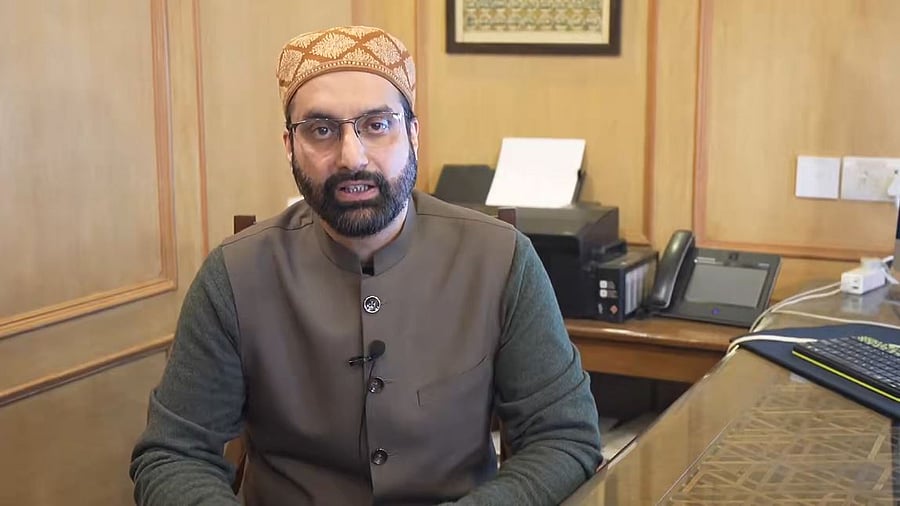
Senior separatist leader Mirwaiz Umar Farooq.
Credit: X/ @MirwaizKashmir
Srinagar: Despite the abrogation of Article 370 and the downgrading of Jammu and Kashmir to a Union Territory in 2019, the Kashmir conflict “continues to keep the region in an unsettled state that can erupt anytime,” senior separatist leader Mirwaiz Umar Farooq said on Friday, warning of a deepening crisis in the Valley.
In a hard-hitting social media statement, Mirwaiz, who is also Kashmir’s chief cleric, reflected on 2025 as “a year marked by tragedy and uncertainty.” He cited the horrific Pahalgam attack, which left people in fear as homes were demolished, followed by another India–Pakistan conflict that highlighted the fragility of peace in the region.
The year concluded with the massive blast in New Delhi, which further deepened anxiety for Kashmiris already living under suspicion and punitive measures in parts of India, he said.
“Beyond these incidents, not much has changed for Kashmiris,” Mirwaiz said. He lamented the widening trust deficit with New Delhi, noting that enforced silence is projected as acquiescence, wounds remain unhealed, and the elected government of the Union Territory continues to operate under constraints. He described a sense of hopelessness prevailing in the Valley, compounded by an existential crisis stemming from demographic changes, withdrawal of constitutional guarantees, and unilateral administrative adjustments since 2019.
Mirwaiz also criticized the banning of the Awami Action Committee and Ittihadul Muslimeen, key socio-political institutions that were part of the Hurriyat Conference, saying much of the political and public space has been extinguished. “Today, any expression of views contrary to the state is increasingly criminalized, branded as ‘anti-national,’ and penalized,” he said.
Highlighting the personal impact of these restrictions, Mirwaiz revealed that he was placed under house arrest for fourteen Fridays in 2025 and again on the first Friday of 2026, severely limiting his access to the Jama Masjid pulpit, the spiritual heart of Kashmir. He also noted restrictions on press conferences, movement, and public meetings, calling social media the only remaining platform to communicate with the people and the outside world.
On his recent decision to remove Chairman Hurriyat Conference from his bio on X, he said: …when pressed to make changes to my social media profile — as Hurriyat constituents are banned under UAPA, displaying the title would be considered illegal and the platforms barred to me — I was left with little choice but to safeguard the minimal channel of communication available to me or face the risk of complete silencing, as even today I am addressing you through this channel when I am again put under house arrest.”
“Some have criticised this move as a compromise. To them I say, how and for what? They make a strange argument — for being provided security. But it was provided to me since the day of my father’s martyrdom 35 years ago. If I did not compromise for it since then, why should I compromise now?” the Mirwaiz asked.
Despite the grim reality, Mirwaiz stressed the importance of dialogue as the only path toward peace and reconciliation. Recalling past engagements with Indian leaders, including former Prime Ministers Atal Bihari Vajpayee and Manmohan Singh, as well as BJP leader L.K. Advani, he emphasized his continued commitment to representing the aspirations of all Kashmiris, irrespective of religion, region, or affiliation, including the plight of youth in detention and the rights of displaced Kashmiri Pandits.
Concluding on a note of cautious optimism, he said, “Is real peace possible? Yes. Kashmiris are natural optimists. Dialogue has worked elsewhere, and our hope remains alive.”