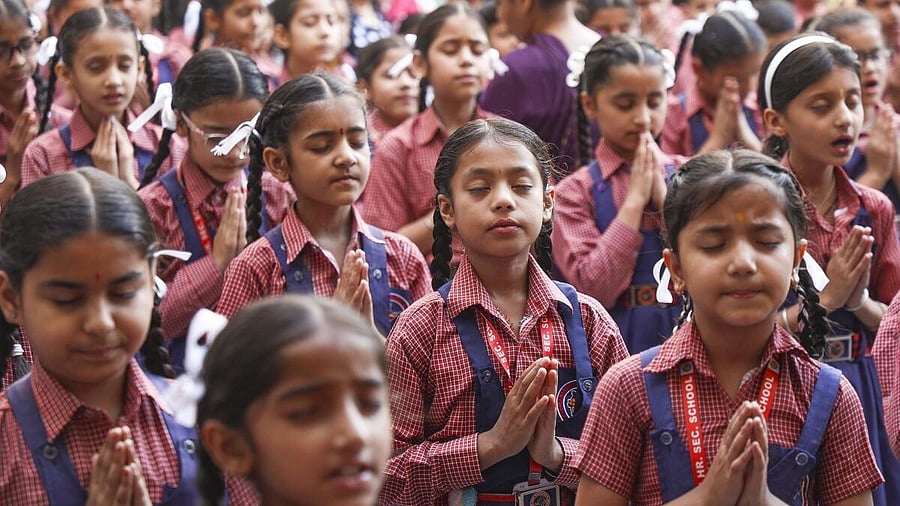
Students attend a prayer meet at a school after educational institutions reopened in Jammu.
Credit: PTI Photo
Srinagar: In villages across Jammu and Kashmir, a quiet but consequential change is unfolding in how parents choose schools for their children.
Increasingly, families are opting for Army Goodwill Schools (AGSs) and Jawahar Navodaya Vidyalayas (JNVs), institutions once viewed with suspicion by sections of society but now valued for academic performance, discipline and national-level exposure.
The shift is subtle, driven by pragmatism rather than politics, yet it reflects a growing trust in national institutions as pathways to stability and opportunity.
AGSs, run by the Indian Army under ‘Operation Sadbhavana’, operate more than 40 schools across J&K and educate thousands of students, largely from remote and conflict-affected areas. Over the years, these schools have built a reputation for consistent teaching and strong results in CBSE Class 10 examinations.
Officials associated with the programme say there has been sustained local demand, with repeated calls from communities for opening more such schools.
“For parents like us, the attraction is simple: regular classes, good English education and discipline,” said Ghulam Nabi, a shopkeeper from north Kashmir whose son studies at an AGS. “We want our children to compete with students anywhere in India. That matters more to us than old political arguments.”
A similar aspiration is visible in the growing interest in JNVS, the centrally run, residential schools that admit rural students through a competitive nationwide entrance test.
Several JNVs function across districts in J&K, offering free education, boarding and a curriculum affiliated with CBSE. Securing admission is considered prestigious, and alumni from the region have gone on to professional colleges and universities, reinforcing parental confidence.
Education officials say the appeal of these institutions lies partly in contrast to local challenges. Government schools have improved enrolment overall, but concerns remain about infrastructure and frequent disruptions in some areas.
Private schools, meanwhile, are often expensive and out of reach for rural families. Against this backdrop, AGSs and JNVs offer a combination of affordability, structure and wider exposure.
“There is a noticeable shift in how parents evaluate schooling,” said an education officer in south Kashmir. “The discussion at home is about outcomes — safety, results and opportunities — not ideology. National institutions are increasingly seen as dependable options.”
The change has not been without debate. In the past, separatist leaders publicly objected to parents sending children to Army-run schools, underscoring how education choices were once deeply politicised.
Today, however, many families appear less inclined to frame schooling decisions in ideological terms, focusing instead on what they see as long-term benefits for their children.
There is no official data yet to quantify a sharp surge in enrolments or to map these choices directly to political attitudes. But the steady popularity and local demand for AGSs, along with the enduring competitiveness of Navodaya admissions, point to a broader social recalibration.
In Kashmir, where political processes and security measures have long dominated narratives of integration, the more enduring change may be happening quietly — in classrooms, hostels and examination halls — as parents place their faith in education as the safest bridge to stability and national opportunity.