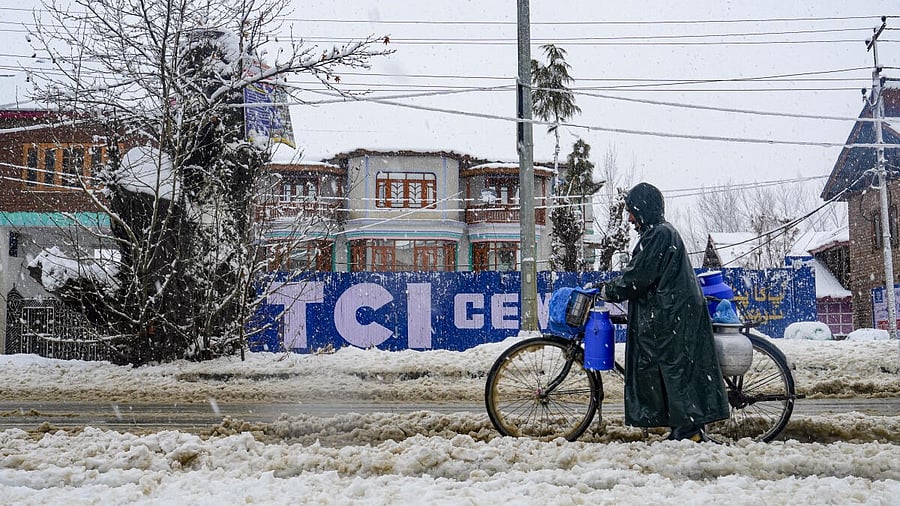
A milkman makes his way through a snow-covered street during snowfall on the city's outskirts, in Srinagar, Jammu and Kashmir
Credit: PTI photo
Srinagar: The renewed political debate on dividing Jammu and Kashmir (J&K) has unsettled a region that is still absorbing the impact of the 2019 constitutional overhaul.
For readers outside Jammu and Kashmir, the discussion can be confusing. After all, the region was already reorganised when Article 370 was revoked and Ladakh was separated as a Union Territory (UT) in August 2019. What, then, does this new talk of “division” refer to?
The current debate centres on the idea of splitting the UT of Jammu and Kashmir internally, most commonly by carving out a separate Jammu state while leaving the Kashmir Valley as a distinct political unit.
This is not a proposal for secession or international realignment. It is framed as an internal administrative reorganisation, similar in form — though not in context — to the creation of new states elsewhere in India.
Why this is not a routine administrative question
Legally, Parliament has the authority to redraw state and UT boundaries. Precedents exist. Politically, however, J&K is an exception. Its boundaries have been shaped by conflict, federal intervention and prolonged political instability. Any further division would therefore carry meanings that go well beyond governance efficiency.
A split would reconfigure political representation in a fundamental way. Parties rooted in the Kashmir Valley have historically operated within a framework where they could claim to represent the entire former state. A separate Jammu state would end that arrangement, consolidating political power along regional lines. For some leaders, this offers clarity. For others, it represents political marginalisation.
The identity question
Any proposal to divide J&K also intersects with identity in ways that are difficult to ignore. The Kashmir Valley is overwhelmingly Muslim, while Jammu has a Hindu majority. A formal political separation along regional lines would therefore risk being perceived — domestically and internationally — as a communal partition, even if the stated rationale is administrative.
Security analysts warn that such an outcome could unintentionally strengthen long-standing secessionist narratives in the Valley that portray Kashmir as culturally and politically distinct from the Indian Union.
In a region where symbolism has often carried strategic weight, the optics of separating a Muslim-majority region could be used by separatist groups and hostile external actors to revive claims of exclusion and unresolved sovereignty.
Governance arguments — and their limits
Supporters of division argue that J&K have different developmental priorities, languages and administrative needs and that a single framework has failed to accommodate these differences.
Separate political units, they contend, would allow for more responsive governance.
Critics counter that administrative fragmentation does not automatically address deeper problems such as unemployment, weak institutions and limited political trust. They also caution that division could trigger fresh demands for further sub-regional units, opening a cycle of fragmentation without resolving underlying grievances.
Why the issue keeps returning
The debate has gained traction amid persistent perceptions of regional imbalance. Disputes over recruitment, reservations and access to public employment have repeatedly sharpened regional anxieties.
A recent judicial services examination, in which candidates from Jammu overwhelmingly dominated the list, became a flashpoint, even as authorities defended the process as merit-based.
Similar controversies around reservation categories, language requirements and certification procedures have reinforced the sense that opportunities are unevenly distributed.
Individually, these disputes are administrative. Collectively, they have political consequences.
Is division likely?
At present, there is no formal proposal before Parliament, and no clear political consensus in favour of division. Major parties, including those at the Centre, have publicly rejected the idea.
But the persistence of the debate is significant. It suggests that the 2019 reorganisation did not settle J&K’s internal questions — it merely reframed them. Whether those questions are addressed through reform within the existing structure or through renewed demands for redrawing boundaries remains an open political challenge.