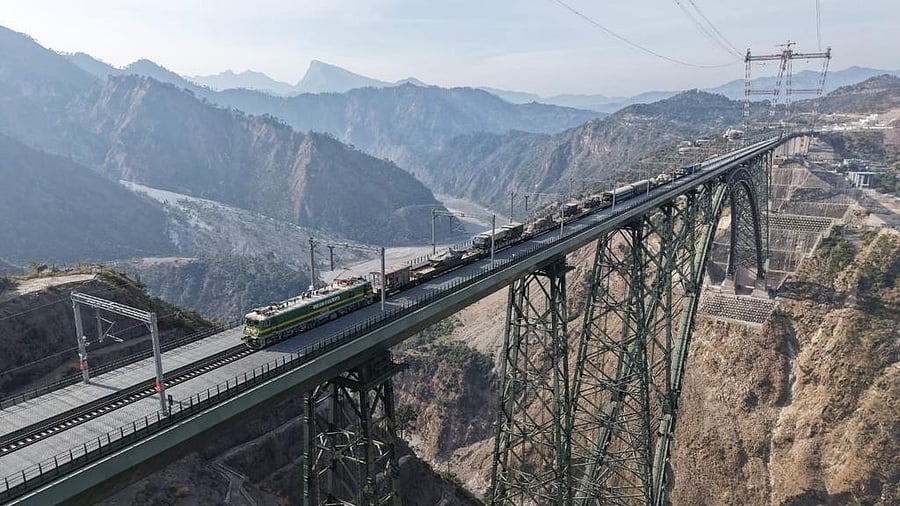
Rail-based logistics offer a more secure and predictable alternative, defence analysts say.
Credit: X/@prodefencejammu
Srinagar: Railway connectivity to the Kashmir Valley is beginning to alter how the Indian Army moves heavy equipment and sustains forces in the region, offering a more reliable logistics option in a sensitive border state where terrain, weather and security conditions have long constrained military mobility.
The significance of the shift came into focus this week when the Army inducted tanks and artillery guns into the Valley through a Military Special Train. The movement, conducted as part of a validation exercise, involved the transport of armoured platforms, artillery systems and heavy engineering equipment from the Jammu region to Anantnag in south Kashmir.
In a post on X, the Army said the induction demonstrated enhanced mobility and logistical capability and was achieved in close coordination with the Ministry of Railways. The exercise underscored the operational relevance of the Udhampur-Srinagar-Baramulla Rail Link (USBRL), which provides all-weather rail access to the Valley for the first time.
For decades, the Army’s logistics pipeline into Kashmir has been heavily dependent on the Jammu-Srinagar National Highway, a lifeline that remains vulnerable to landslides, snowfall and weather-related closures. Disruptions to the highway have often complicated troop movement and delayed the induction of heavy equipment, particularly during winter and periods of heightened security.
Rail-based logistics offer a more secure and predictable alternative, defence analysts say. The ability to move tanks and artillery by train allows bulk and discreet movement of assets, reduces reliance on exposed road convoys and eases pressure on limited airlift capacity. In a border region where mobility and sustainment are closely linked to deterrence, such capabilities are viewed as critical.
The development also has implications for preparedness along the Line of Control and other northern frontiers. Faster induction of equipment enables quicker reinforcement during crises, better rotation of forces and improved capacity to sustain prolonged deployments in forward areas.
Officials say the rail link will also support routine military logistics, including the movement of fuel, rations and construction material needed for infrastructure and habitat maintenance in high-altitude areas. This is expected to improve operational endurance while simultaneously reducing congestion and risk on civilian road networks.
Security analysts note that the growing defence use of the USBRL highlights the strategic importance of dual-use infrastructure in conflict-prone regions.