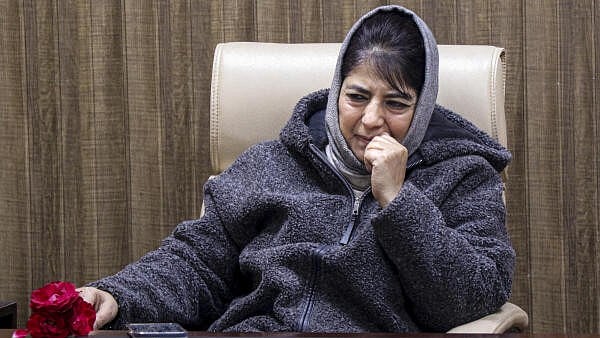
Peoples Democratic Party (PDP) President Mehbooba Mufti
Credit: PTI Photo
Srinagar: The High Court of Jammu & Kashmir and Ladakh has dismissed a public interest litigation filed by Peoples Democratic Party (PDP) president and former chief minister Mehbooba Mufti seeking the repatriation of undertrial prisoners lodged in jails outside the Union Territory.
While acknowledging that the issue raised touches upon concerns often voiced by families of detainees, the court held that the petition failed to meet the legal standards required for invoking public interest jurisdiction.
A division bench of Chief Justice Arun Palli and Justice Rajnesh Oswal found the plea to be broadly worded, lacking factual backing and specific details. The judges stressed that public interest litigation must be founded on verifiable material and cannot be used - directly or indirectly - to advance political narratives or partisan positions.
Mufti had sought directions to the Union government and the J&K administration to immediately transfer all undertrial prisoners belonging to the Union Territory from prisons outside J&K, unless authorities could justify such detention on compelling and unavoidable grounds.
The petition also asked for a formal access regime, including weekly family visits, unhindered meetings between lawyers and clients, reimbursement of travel expenses for families, and the creation of a two-member oversight committee to examine prison transfers and ensure compliance.
However, the bench noted that the petition rested on general claims. Although the petitioner stated that several families of undertrials had approached her, she did not place on record the name of a single prisoner, the nature of the cases involved, or any specific transfer order under challenge.
The court observed that the lodging of undertrials outside Jammu and Kashmir was not a routine or uniform practice but was based on individual decisions taken by competent authorities in the peculiar facts of each case. In the absence of such material, the court said, issuing sweeping or “omnibus” directions would be legally impermissible.
The judges also took note of Mufti’s position as the president of a major opposition party, observing that while political leaders often raise public concerns, courts must remain cautious that PIL jurisdiction is not perceived as a tool for political projection. Constitutional courts, the bench reiterated, are not forums for political messaging, even when the subject matter carries emotional or social resonance.
At the same time, the court acknowledged that the rights of undertrial prisoners and their families are important constitutional concerns. It pointed out that undertrials have well-established remedies available to them, including the right to approach courts individually and access to legal representation through the Legal Services Authorities Act.
The absence of any petition from the affected undertrials themselves, either directly or through legal aid mechanisms, weighed against the claim of genuine public interest.
Referring to Jammu and Kashmir’s security challenges and history of violence, the bench noted that the petitioner herself had conceded that exceptional circumstances could warrant detention outside the Union Territory, yet the plea failed to identify or substantiate any such cases.
Concluding that a prima facie case of bona fide public interest had not been made out, the High Court dismissed the petition, underscoring that preventing misuse of judicial processes is itself a matter of public interest.