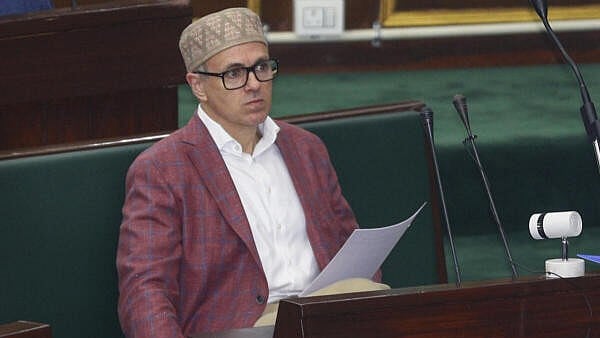
Jammu and Kashmir Chief Minister Omar Abdullah during the Budget session of the legislative Assembly, in Jammu.
Credit: PTI Photo
Srinagar: Jammu and Kashmir Chief Minister Omar Abdullah on Friday tabled a Rs 1,13,767 crore Budget for the Union Territory for 2026-27, outlining allocations for revenue and capital outlays while underscoring the fiscal challenges facing the region.
Presenting the financial blueprint in the UT Assembly, Abdullah said the total net Budget estimates of Rs 1,13,767 crore exclude provisions for ways and means advances and overdraft. Of this, Rs 80,640 crore has been earmarked for revenue expenditure and Rs 33,127 crore for capital expenditure, highlighting the balance between operational costs and new investments.
According to the figures shared in the House, expected revenue receipts under the Budget Estimates stand at Rs 90,018 crore, while capital receipts are projected at Rs 23,749 crore for the coming fiscal year. Abdullah said the Union Territory’s own revenues from both tax and non-tax sources are estimated at Rs 31,800 crore, reflecting limited internal resources relative to overall spending.
The Chief Minister highlighted the importance of external support, noting that Rs 42,752 crore is expected from central assistance, along with Rs 13,400 crore under Centrally Sponsored Schemes — funds that remain critical given the UT’s resource constraints.
This is the second Budget presented by Abdullah as Chief Minister of the Union Territory, following his first fiscal plan of Rs 1.12 lakh crore in March 2025 which included welfare measures such as free travel for women on government buses and other social benefits.
Analysts note that Jammu and Kashmir’s finances remain under pressure, with own revenues covering only a fraction of expenditure and a heavy reliance on central transfers — a pattern typical of the region’s fiscal profile.
According to data from the Jammu and Kashmir Economic Survey, revenue collections in the previous year showed growth in tax and non-tax receipts, particularly in GST, excise and power sectors, even as public debt and committed spending continue to pose challenges.
The budget session is expected to spark debates in the Assembly over priorities such as job creation, infrastructure development and equitable growth across regions.