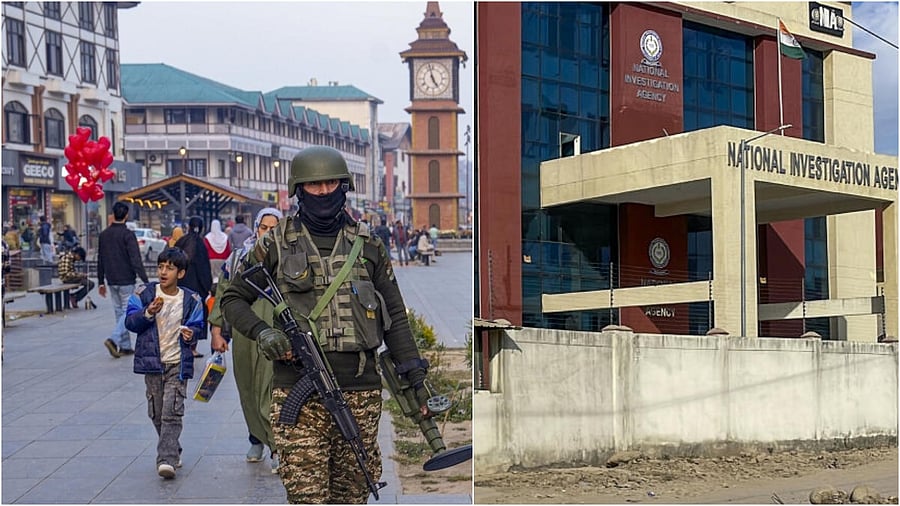
File image of armymen in J&K(L), NIA team arrives to present a charge sheet in Pahalgam terror attack case before a NIA special court, in Jammu.
Credit: PTI Photos
Srinagar: The National Investigation Agency (NIA) has named Pakistan-based Lashkar-e-Taiba (LeT) operative Sajid Jatt, a native of Kasur district in Pakistan’s Punjab province, as a key conspirator behind the April 22 Pahalgam terror attack that left 25 tourists and a local civilian dead, formally tracing the plot to handlers operating from across the border.
In a 1,597-page chargesheet filed before the NIA Special Court in Jammu ahead of the statutory deadline under the Unlawful Activities (Prevention) Act (UAPA), the agency has named seven accused, including Sajid Jatt, describing him as a Pakistan-based handler who coordinated the attack through Lashkar-e-Taiba and its proxy outfit, The Resistance Front (TRF).
The attack took place at Baisaran meadow, a popular tourist destination near Pahalgam often referred to as “mini Switzerland”, when heavily armed terrorists opened fire on visitors during peak tourist season. The killings triggered nationwide outrage and dealt a severe blow to Kashmir’s tourism.
In a significant legal step, the NIA has formally charged both LeT and TRF as terrorist entities in the case, invoking provisions of the Bharatiya Nyaya Sanhita (BNS), the Arms Act, 1959, and multiple sections of the UAPA, including those related to waging war against India. Officials said the chargesheet is supported by forensic, digital and technical evidence collected over nearly eight months.
The agency has also named three Pakistani terrorists killed in an encounter during ‘Operation Mahadev’ at Dachigam, on the outskirts of Srinagar, in July—weeks after the attack. They were identified as Faisal Jatt alias Suleman Shah, Habeeb Tahir alias Jibran, and Hamza Afghani, all affiliated with the banned LeT outfit.
According to the NIA, two local residents of Pahalgam—Parvaiz Ahmad and Bashir Ahmad Jothar—were arrested on June 22 for allegedly harbouring the terrorists and providing logistical support. During interrogation, the duo disclosed the identities of the gunmen and confirmed that the attackers were Pakistani nationals who had infiltrated across the Line of Control (LoC).
Investigators said the attackers received ground support in south Kashmir, enabling them to strike a crowded civilian location before fleeing. The probe, registered as RC-02/2025/NIA/JMU, concluded that Pakistan continues to sponsor terrorism in Jammu and Kashmir through proxy outfits like TRF, which was created to give a local façade to Pakistan-based groups following the abrogation of Article 370.
The Pahalgam killings were followed by a sharp escalation in tensions between India and Pakistan, culminating in a four-day limited military confrontation from May 7 to May 10, involving cross-border firing, drone activity and precision strikes.
While Pakistan has denied any role, Union Home Minister Amit Shah later told Parliament that the involvement of Pakistan-based LeT operatives in the attack had been established. The NIA said further investigation is ongoing, even as the case now moves into the trial phase.
Pahalgam attack: Timeline of key events
April 22: Terrorists kill 25 tourists and a local
May 7–10: Limited India–Pakistan military confrontation
June 22: Two local men arrested for harbouring attackers
July 28: Three Pakistani terrorists killed in ‘Op Mahadev’
Dec 15: NIA files chargesheet before Special Court, Jammu
Terrorism & Tourism:
Before April 22
Tourist footfall rising
Hotels near full occupancy
Improved security perception
After April 22
Mass cancellations across south Kashmir
Increased armed presence at tourist spots
Advisory-driven travel slowdown
Kashmir militancy: Changing pattern
Shift from security forces to soft civilian targets
Increased use of proxy outfits after Article 370
Emphasis on high-visibility attacks to draw attention