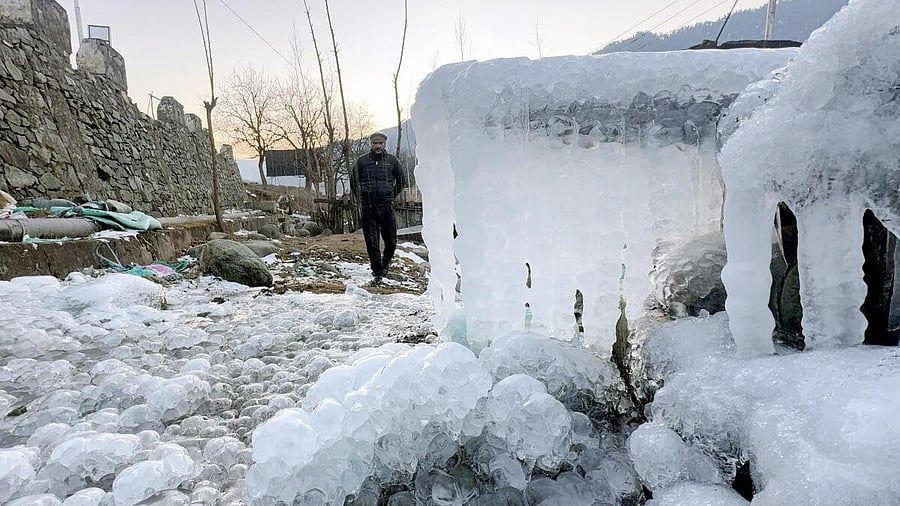
A man walks past icicles hanging from a structure amid heavy frost and snow cover during a cold wave in the valley, in Anantnag district.
Credit: PTI photo
Srinagar: Kashmir is witnessing a second consecutive year of unusually low snowfall during ‘Chillai Kalan’, reinforcing concerns among scientists and residents that the Valley’s winter patterns have undergone a long-term shift, with snowfall becoming increasingly unpredictable and poorly timed.
‘Chillai Kalan’, the 40-day harshest phase of winter beginning December 21, has traditionally been the backbone of Kashmir’s snow calendar, ensuring sustained snow cover, groundwater recharge and ecological stability.
This winter, as with last year, more than half of the period has passed without any major snowfall across the plains and middle reaches, despite sub-zero temperatures and intermittent snow in higher altitudes.
Climate experts note that the problem is not just reduced snowfall, but a change in its timing. Over the past few decades, Kashmir has seen a steady decline in snowfall during ‘Chillai Kalan’, even as isolated heavy spells are increasingly recorded earlier in November or towards the fag end of winter in February. This shift has disrupted the natural rhythm of snow accumulation and melt that the Valley depends on.
Meteorological officials attribute the trend to weak and erratic Western Disturbances, which are arriving either too early or too late in the season, bypassing the peak winter window.
Scientists link this growing unpredictability to climate change, which is altering temperature profiles and precipitation behaviour across the western Himalayas.
The consequences are already unfolding. Water shortages are being reported in several rural areas, where springs and small streams—largely sustained by winter snow—are showing reduced discharge. With two successive low-snow ‘Chillai Kalan’ periods, experts warn that groundwater recharge has been severely impacted, increasing the risk of water stress in spring and summer.
Health officials say the prolonged dry winter has led to dusty conditions, contributing to a rise in respiratory and skin-related ailments. Snow normally suppresses dust and pollutants; its absence allows them to remain suspended in the cold air for longer periods.
Unusually, forest fires have also been reported during winter, a phenomenon once considered rare in Kashmir. Forest officials attribute this to dry conditions and reduced moisture in forest floors.
Renowned Kashmiri environmental scientist Prof. Shakil Romshoo, Vice Chancellor of the Islamic University of Science and Technology, says the back-to-back dry Chillai Kalan spells reflect a deeper climatic shift.
“Winter precipitation in Kashmir used to fall largely as snow during Chillai Kalan,” Romshoo said. “Now snowfall is declining in this crucial period and shifting to November or February. This change in timing is as serious as the decline itself and is clearly linked to climate change.”
The altered snowfall pattern is also affecting winter tourism, particularly in snow-dependent destinations such as Gulmarg and Pahalgam, where economic activity hinges on reliable snow cover. Farmers and orchardists, especially apple growers, fear that poor snow accumulation during peak winter could affect soil moisture, chill hours and crop productivity.
Environmentalists caution that while variability is natural, two successive dry Chillai Kalan winters underline a worrying trend. As snowfall becomes erratic and mistimed, Kashmir faces mounting challenges in securing water resources, protecting fragile ecosystems and adapting its economy to a rapidly changing climate.