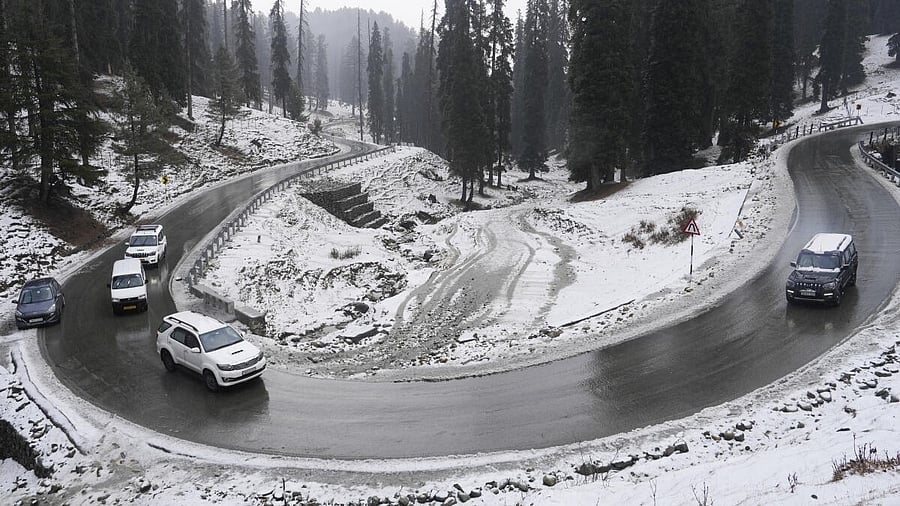
Vehicles pass through a snow-covered valley after fresh snowfall on the first day of ‘Chillai Kalan’, in Gulmarg, Baramulla district, Jammu and Kashmir, Sunday, Dec. 21, 2025. ‘Chillai Kalan’ is a 40-day harsh winter period in Kashmir which begins on December 21 every year and ends on January 31.
Credit: PTI Photo
Srinagar: Kashmir’s 40-day harshest winter phase, ‘Chillai Kalan’, set in on Sunday with snowfall in the upper reaches and rain in the plains, ending a nearly two-month dry spell and bringing much-needed relief to the Valley’s environment, economy and water systems.
Popular tourist destinations Gulmarg and Sonamarg received their first snowfall of the season, instantly transforming the landscape and reviving hopes of a strong winter tourist rush ahead of Christmas and New Year celebrations.
Hoteliers and tour operators, who had been bracing for a dull festive season due to the prolonged absence of snow, said bookings began picking up soon after visuals of snow-clad slopes circulated on social media.
“This snowfall is a game-changer for winter tourism,” a hotelier in Gulmarg said. “If it continues over the next few days, we expect a surge in visitors, especially skiers and holidaymakers.”
Beyond tourism, the precipitation has wider economic and ecological significance. The rain and snow cleared accumulated dust and suspended particulate matter from the air, sharply improving air quality after weeks of dryness. Residents, particularly those suffering from respiratory ailments, reported immediate relief as the air turned cleaner and heavier with moisture.
Meteorological officials said the overnight cloud cover pushed up minimum temperatures across the region. Srinagar recorded a minimum of 4°C, while Gulmarg and Pahalgam recorded minus 1.5°C and 2.8°C, respectively. In the Jammu region, minimum temperatures were recorded at 11.5°C in Jammu city, 11.6°C in Katra, 7.6°C in Batote, 6°C in Banihal, and 5.8°C in Bhaderwah.
However, the snowfall also led to temporary disruption of road links in high-altitude areas. Authorities suspended traffic on the Srinagar–Leh national highway due to snow accumulation near the Zojila Pass, while vehicular movement was also halted across Sadna Top in Kupwara, Razdan Pass in Bandipora, and Sinthan Pass in Anantnag as a precaution.
Environmentalists say snowfall during ‘Chilla Kalan’ is vital for agriculture, horticulture and hydropower generation. The snowpack in higher reaches acts as a natural reservoir, feeding rivers, streams, springs and lakes during the summer months. This, in turn, sustains irrigation for orchards and farmlands and ensures steady water flow for hydropower projects, a major energy source for Jammu and Kashmir.
“Winter snow is our insurance for summer,” an agriculture department official said. “Good snowfall now means better soil moisture, healthier orchards and reliable water availability in the months ahead.”
The Meteorological Department has forecast more rain in the plains and snowfall in higher reaches over the next 24 hours, raising hopes of a sustained snow spell as Chilla Kalan begins in earnest.
As Kashmir steps into its coldest days, the first snowfall has brought more than winter chill—it has rekindled tourism prospects, refreshed the air, and strengthened the natural systems that underpin the region’s economy and livelihoods.