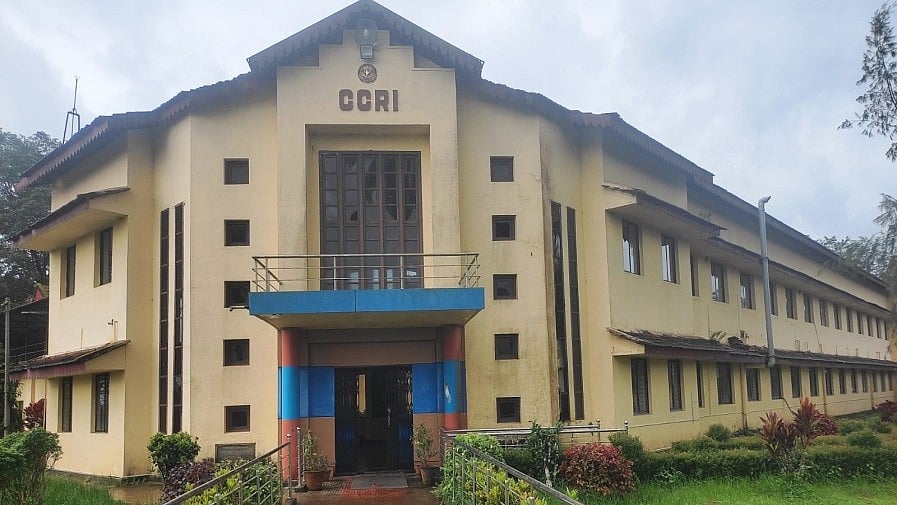
The Central Coffee Research Institute at Balehonnuru in Chikkamagaluru district is set to mark its centenary with celebrations planned from December 20-22.
Credit: CCRI
Nestled amid the misty peaks of Chikkamagaluru and the valleys of Kodagu, the Central Coffee Research Institute (CCRI) at Balehonnuru has quietly shaped the course of Indian coffee for a century. By applying science and sustained research, the institute helped fragile plantations, once vulnerable to pests and price shocks, evolve into a globally recognised, resilient and sustainability-focused industry.
Here, flowers, cherries, foliage and soil form a living laboratory where science and nature work together to produce a great cup of coffee, one that sustains livelihoods and carries culture and legacy. Legend has it that coffee first arrived in India in the 17th century, when Baba Budan sowed seven sacred seeds in the hills of Chikkamagaluru. Over the centuries, cultivation spread across the lush slopes of the Western Ghats. By the 19th century, organised plantations under British rule brought both opportunity and risk, exposing coffee to pests, diseases and fluctuating yields, and making scientific intervention not just helpful, but essential.
Recognising this need, the Mysore Government, under the reign of Nalwadi Krishnaraja Wadiyar, established the Mysore Coffee Experimental Station at Balehonnuru in 1925, led by Dr L C Coleman, then joint director of agriculture. Its mission was simple yet ambitious: develop disease-resistant varieties and scientific pest management techniques. What began as a modest research station soon became the nerve centre of Indian coffee science. The 1940s tested this resolve. World War II disrupted trade, prices collapsed and plantations faced severe pest and disease pressures. In response, the Coffee Act was enacted, and the Coffee Board of India was formed in 1946, elevating Balehonnuru station to national status as the Central Coffee Research Institute and marking the dawn of science-led coffee development.
Today, CCRI has substations at Chettalli (Kodagu) and regional research stations in Kerala, Tamil Nadu, Andhra Pradesh and Assam, developing technologies that respond to India’s diverse coffee-growing conditions. Research at CCRI spans plant breeding and genetics, agronomy, soil science, plant physiology, pathology, entomology, biotechnology, tissue culture and post-harvest technology, each contributing to productivity, quality and sustainability of coffee.
Spread over 134 hectares, CCRI houses modern laboratories, experimental farms, demonstration plots, quality evaluation units, a library of rare coffee literature and a national gene bank that preserves hundreds of wild coffee species and developed varieties. Over 112 scientists continue to push the boundaries of knowledge, transforming research into practical solutions for growers.
Among CCRI’s lasting contributions is systematic breeding and multi-location trials, which have resulted in the institute releasing 13 arabica selections along with several robusta varieties and hybrids. These varieties offer higher yields, resistance to leaf rust and wilt, improved cup quality and better adaptability to climate challenges, enhancing farmer resilience and income. Advanced facilities like the Flux Tower and FASAL Tower monitor microclimate, carbon exchange and weather parameters, providing insights for climate-resilient coffee farming.
Impact beyond laboratory
CCRI’s impact extends far beyond the laboratory. Growers have access to quality seeds, biocontrol agents, soil and leaf analysis, training programmes, field demonstrations and consultancy.
Senthilkumar, Director of Research at CCRI, highlights that the institute’s focus on climate-resilient varieties and precision farming has positioned India as a premium global coffee origin.
Coffee Board of India Chairman M J Dinesh says that the board aims to produce five lakh tonnes of coffee, with a growing share of specialty grades backed by sustainability standards.
Appreciating CCRI’s contribution,
K N Subrahmanya, a farmer leader, said that CCRI’s farmer-centric research is essential to sustain livelihoods amidst climate change and global competition. He said the key challenge lies in developing region-specific, drought-tolerant, high-performance coffee varieties.
From producing 10,000 tonnes in its early years to over 3.6 lakh tonnes today, India’s coffee story is deeply intertwined with CCRI’s journey. As the institute marks its centenary, its legacy continues to nurture the land, support growers, and delight coffee lovers around the world.
A scientist at work at the Central Coffee Research Institute at Balehonnuru in Chikkamagaluru. Photo/ CCRI
Credit: CCRI
Students under training at the Central Coffee Research Institute.
Credit: CCRI