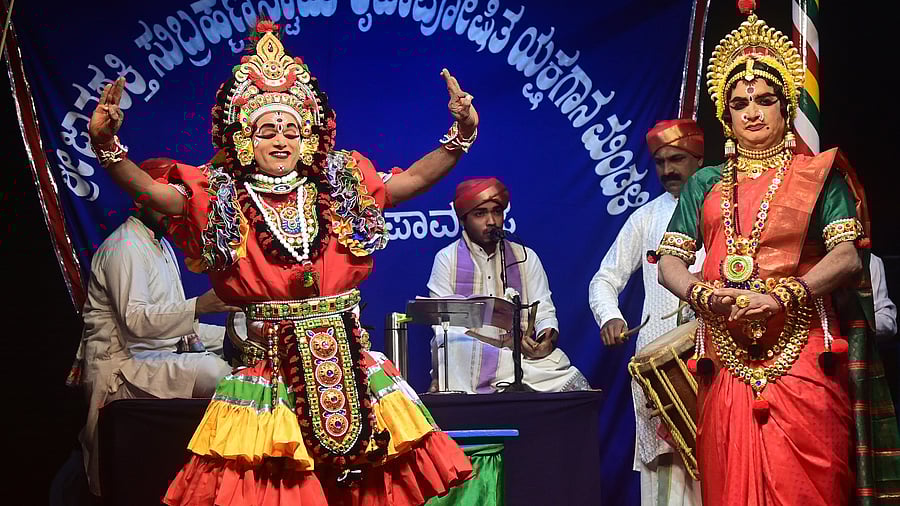
Yakshagana artistes of the Pavanje Mela perform 'Chayanandana', a Harake Yakshagana show, near Kadri Temple in Mangaluru.
Credit: Fakruddin H
In the coastal districts of Karnataka, Harake Yakshagana Bayalata troupes follow a performance tradition unlike any other. Their calendars are often filled years, and sometimes decades, in advance.
Yakshagana Bayalata Harake Seve, the centuries-old practice of hosting Yakshagana performances to fulfil a vow or promise, has seen unprecedented demand in recent years. Though the origin of the practice is unclear, devotees seek not only spiritual fulfillment through these shows but also a deep connection with an art form rooted in the region’s culture. Consequently, popular Tenkuthittu and Badaguthittu Harake Melas (troupes) now face long waiting lists, with patrons eager for an opportunity to host a performance (or an aata).
For many devotees, securing a slot for such a performance can mean waiting 10 to 20 years, with fresh bookings arriving year after year.
To meet this rising demand, several prominent temples maintain multiple troupes that tour villages and towns from November to May, performing episodes drawn from mythology. These shows, free for the public, usually begin after dusk and continue late into the night, drawing large audiences from nearby places.
Among the sought-after troupes is the Mandarthi Shree Durgaparameshwari Dashavatara Yakshagana Mela in Udupi district. With five troupes and around 225 artistes and support team members, its bookings extend until 2045–46. “People organise performances when their wishes are fulfilled,” says Dhananjay Shetty of the temple trust. Two troupes perform regularly at the temple from June to November, and the performance charge is Rs 32,000 per show.
The Kateel Sri Durgaparameshwari Prasadita Dashavatara Yakshagana Mandali in Dakshina Kannada district has also grown to meet the rising demand, recently adding a seventh troupe. Despite staging around 1,260 shows annually, the mela still faces a backlog of around 10 years. According to temple trustee Harinarayan Asranna, Devi Mahatme is the most sought-after episode. The performance charge for a show is Rs 80,000.
The Shri Dharmasthala Manjunatheshwara Krupaposhita Yakshagana Mandali, a major Harake Mela from Dakshina Kannada, tours districts across Karnataka and in Kerala's Kasaragod, staging about 190 shows annually. “Around 2,000 shows are already booked, which will take the next 10 years to clear,” said manager Girish Hegde.
In Udupi, the Shri Brahmalingeshwara Dashavatara Yakshagana Mandali at Maranakatte operates three troupes and has a backlog of nearly 7,000 shows. With 132 artistes, the troupe charges Rs 49,000 per performance, even as new bookings continue to arrive.
Murali Kadekar, honorary secretary of Udupi-based Yakshagana Kalaranga, points out that the Harake Mela tradition not only sustains the art form but also provides livelihoods for thousands of artistes and supporting workers. “Currently, there are over 30 Harake Melas in the region, both large and small, and their numbers continue to grow. Even tent melas, which usually present Yakshagana shows commercially, are now taking up Harake Aatas based on bookings,” he explains.
Nurturing next gen artistes
These troupes play a vital role in nurturing Yakshagana artistes as well. Shri Mukhyaprana Parasadita Yakshagana Mandali at Gundabala in Uttara Kannada district, for instance, has produced stalwarts like Chittani Ramachandra Hegde and Jalavalli Venkatesh Rao.
“This mela does not tour but stages performances on the temple premises for around 145 days a year. Back in 2003, when shows for 12 years were pending, we introduced two performances every night. Even now, the backlog extends for the next eight years,” says the mela manager Prabhakar Chittani.
Yakshagana scholar M Prabhakar Joshi notes that the surge in demand for Harake Melas reflects not only devotion but also improved socio-economic conditions and greater access to cultural engagement in the coastal districts.
Joshi emphasises the role of the community in preserving this living theatre. “Temples, artistes and audiences all share the responsibility of cultivating appreciation for Yakshagana. Experimentation should remain within the framework of the art form, with efforts focused on elevating it rather than compromising its integrity or authenticity,” he adds.
Credit: Fakruddin H
Credit: Fakruddin H
Artistes tie anklets before the Harake Yakshagana tour.
Credit: Fakruddin H
Yakshagana artistes who are part of various Harake Melas affiliated with the Kateel Shri Durgaparameshwari temple collectively perform during the initiation of this year’s tour.
Credit: Fakruddin H
Artistes perform as part of Harake Aata at Gundabala in Uttara Kannada district.
Credit: DH Photo
Artistes of Harake Yakshagana performing at Dharmasthala.
Credit: DH Photo