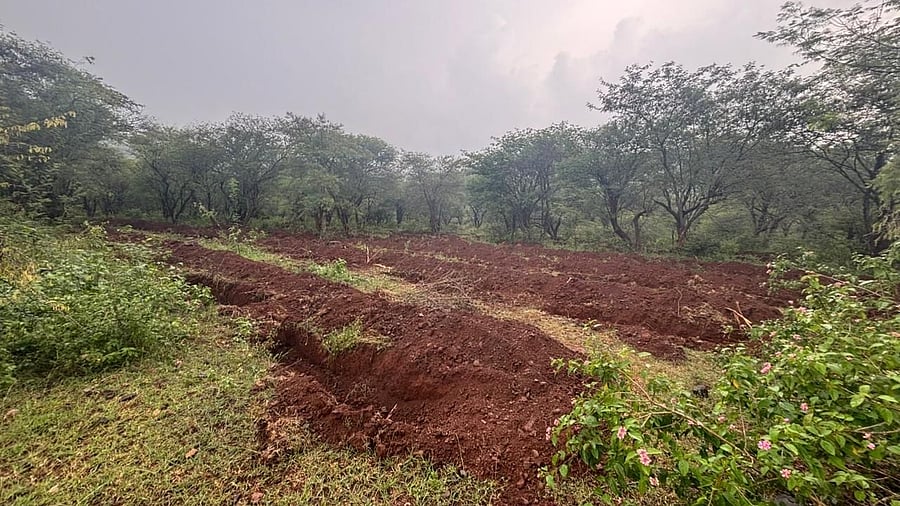
Forest department has dug multiple pits inside Cauvery Wildlife Sanctuary destroying natural grassland area.
Credit: Special arrangement.
Hubballi: To provide fodder for herbivores and improve moisture content in the soil the forest department has dug large pits inside the Cauvery Wildlife Sanctuary by destroying the natural grassland areas.
Wildlife activists have charged that over the last two weeks the forest department has violated multiple rules such as digging pits using heavy earth moving machines in at least three ranges of the wildlife Sanctuary.
Photographic evidence available with DH shows that earth moving machines have destroyed the grasslands in Sangama, Halagur and Mugguru ranges of the sanctuary.
However, Sanctuary’s Deputy Conservator of Forests Surendra M C claims that the pits were dug manually for moisture conservation and prevention of soil erosion purposes.
A wildlife activist, who does not wish to be named, questions the need for creating such pits inside protected areas.
“On one hand the forest department tries to develop grasslands under the garb of providing fodder to wild ungulates claiming that it will reduce human-wildlife conflict. On the other hand the same department is destroying natural grasslands in forests. In both the cases it spends lakhs of rupees- to create grasslands and to destroy grasslands,” he says.
He says grasslands are critical for providing fodder for elephants, sambar, spotted deer, Indian gaur and other herbivores. “The destruction of natural grassland will certainly impact fodder availability to wild ungulates, ultimately increasing human-wildlife conflict. This is illogical and unscientific.”
The activist says the natural grasslands act as rainwater sinking pits and improve groundwater table. “If there is a need for digging pits inside the protected areas to improve groundwater table, then what is the need for the forest,” he questions and adds soaking pits are dug in places where penetration of water into the soil is difficult. Forest soil is rich in nitrogen and they need no external help in recharging groundwater tables.
He also charged that digging of pits in wildlife areas can result in invasive species taking over that space.
A forest guard informed DH that though the department does not have funds to pay salaries of the ground staff for the last two months, they have funds to use machines to destroy the natural habitat.
Refuting all the allegations Surendra stated that digging of pits at these three ranges is part of the Sustainable Sanitation and Water Management (SSWM). “Only manual laborers were used to dig these pits. These pits are essential for soil conservation, prevention of soil erosion, and improving moisture content in soil,” he says and adds the department has not destroyed any grassland; grass can grow in these pits also. “The pits will improve the availability of water to wild animals,” he said.