
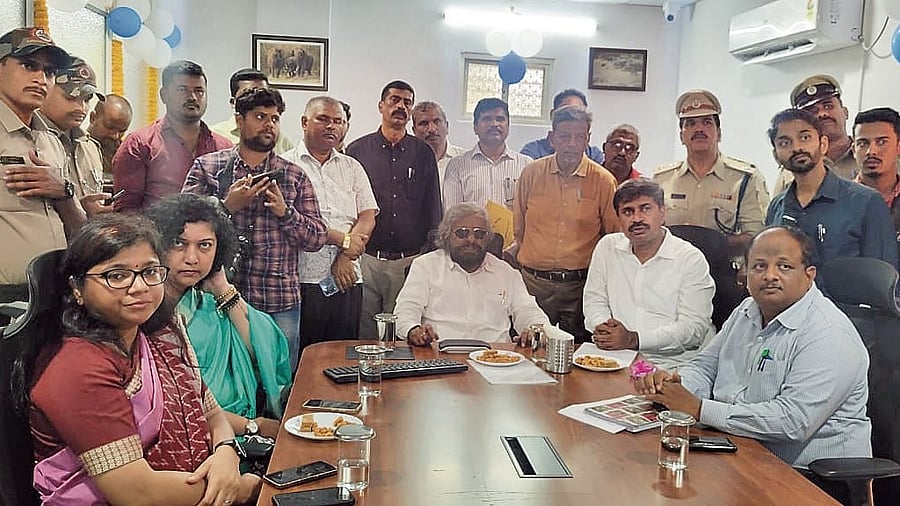
Forest, Ecology and Environment Minister Eshwar B Khandre on Wednesday symbolically launched the Divisional Central Command and Control (CCC) Unit at the MM Hills Wildlife Division office in Kollegal, Chamarajanagar district, marking a major step toward technology-driven wildlife protection, scientific conservation, and effective human–wildlife conflict mitigation.
Khandre said the CCC represents “a major leap” in conservation capacity, using advanced analytics, real-time monitoring, and integrated response systems.
Training and rollout of CCC Units were completed on Wednesday in MM Hills, Nagarahole Tiger Reserve, Kali Tiger Reserve, and Madikeri divisions. Units in Bandipur, BRT, Chikkamagaluru, Hassan, Bannerghatta, and Mysuru divisions will be operational next week.
APCCF Manoj Rajan, who is heading the project, said an integrated state-level CCC will be set up at Aranya Bhavan, Bengaluru.
The CCC Units are real-time technology platforms integrating patrol monitoring, conflict reporting, wildlife tracking, and asset management
into a unified operational system.
Explaining the four key modules, he said the patrolling module uses GPS-enabled tracking of patrol teams, optimised route planning, and live dashboards.
The human–animal conflict and incident reporting module enables field-level reporting of sightings, conflict incidents, and emergencies, with AI-driven image classification and
automated threat prioritisation. The animal tracking module integrates radio collars, camera traps, and sensors for continuous monitoring and predictive analytics to prevent conflict, Rajan said.
The asset and infrastructure management module digitally maps EPTs, barricades, solar fences, sensors, and cameras, and generates maintenance alerts for better planning, he added.
Expected outcomes include reduced emergency response time, data-driven deployment of staff and equipment, predictive modelling to prevent conflict escalation, and unified situational awareness across the department, Rajan said.
Conservator of Forests (Mysuru Circle) S S Ravishankar said the new CCC Units will significantly strengthen the handling of man–animal conflict scenarios through optimal use of manpower and resources.
The Forest Department’s central helpline 1926 will be integrated into the system. While earlier command centres existed in Hassan and BRT, the new CCC Units are “fully advanced,” equipped with real-time information on conflict incidents, behavioural patterns, and movement
of elephants, leopards, and tigers.
He said the centres will maintain a complete communication network of officials and store contact details of forest-fringe residents to send bulk safety alerts. This will reduce response time and help deploy rapid response teams more efficiently.
“People can directly contact the centres, making them more people-friendly,” he added.