
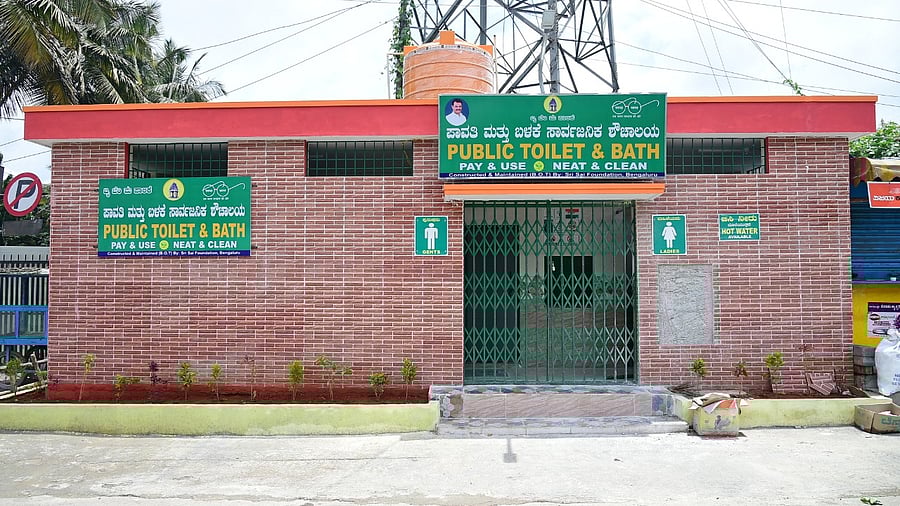
Representative image of a public toilet in Bengaluru.
Credit: DH PHOTO
Bengaluru: Bengaluru NavaNirmana Party (BNP), which audited 38 toilets across 21 wards over the last three months, found most were technically open but usability, dignity and safety for citizens were alarmingly poor.
The audit found these toilets were not friendly to women, persons with disabilities, elderly citizens or transgender persons.
Only 17 of the 38 toilets surveyed, or 44.7%, are fully functional and usable, while 10.5% are completely non-functional or closed. Nearly 55 per cent are partially functional, poorly maintained or unusable.
The findings also pointed to near total exclusion of persons with disabilities, with over 95% inaccessible, 92% having steps blocking entry, and none equipped with usable ramps.
The findings come as Bengaluru Solid Waste Management Ltd prepares to participate in Swachh Survekshan, a nationwide cleanliness survey.
“Bengaluru’s public toilets reflect the state of our governance, built without planning, run without accountability, and ignored until citizens speak up,” the party said.
The party recommended a 30-day rectification drive in every ward to repair flush systems, taps, locks, lighting, broken fixtures and tiles, ensure water supply, install soap dispensers and carry out deep cleaning.
The audit found no dedicated toilets for transgender persons in any ward, forcing them to use women’s toilets. It also noted an acute lack of public toilets and poor visibility or identification in several wards, including Yelenahalli, Bellandur, Nagvarpalya, Kudlu and Hosapalya.
The party sought immediate mapping of all public toilets through Google Maps, supported by clear signage within 500 metres. It also demanded creation of women-safe toilets with CCTV surveillance and women caretakers.