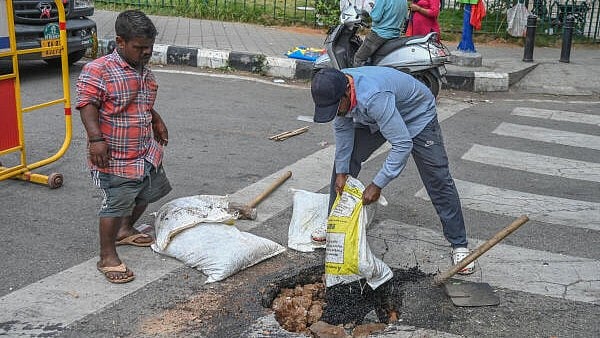
BBMP workers filling sink road by building debris and Ready Asphalt Cbb mix at K L Rahul Circle near Minsk squire, Queens Road in Bengaluru
Credit: DH Photo/ S K Dinesh
Bengaluru: If one issue dominated Bengaluru’s civic conversation through 2025, it was the state of its roads.
Potholes became not just an inconvenience but a public safety concern — particularly for two-wheeler users, who form the bulk of the city’s daily commuters. Many accidents were officially linked to cratered roads, reinforcing a sense that commuting had become a gamble rather than a right.
Faced with mounting public outcry, the Greater Bengaluru Authority (GBA) allocated Rs 65 crore solely for pothole repairs. Within three months, it claimed to have filled more than 30,000 craters across the city. While the scale of the exercise was unmatched in recent years, questions over quality and longevity followed almost immediately.
Public anger over bad roads also pushed the government to announce a grant of Rs 1,241 crore for relaying roads, bundled with associated works such as desilting roadside drains, building shoulder drains, replacing missing kerbs, repairing drain slabs, and fixing damaged footpaths. In addition, the government approved Rs 900 crore for resurfacing 650 km of ward roads or neighbourhood streets.
Both projects are slated to be completed by April–May 2026.
Beyond these two announcements, several other road programmes are scheduled to conclude by the end of 2026. These include asphalting works worth Rs 694 crore, Rs 274 crore for upgrades to 12 high-density corridors, and white-topping of 141 km of roads at an estimated cost of Rs 1,700 crore. Another Rs 450 crore has been earmarked for the development of an 18-km stretch of the Outer Ring Road, which houses one of the city’s largest employment hubs.
Altogether, road-related expenditure in 2026 alone is pegged at Rs 5,259 crore, excluding flyovers, elevated corridors, and tunnel roads. When ongoing works to build new roads along stormwater drain buffer zones — covering about 63 km at a cost of Rs 200 crore — are included, the figure rises further.
Senior officials maintain that the scale of spending will finally reflect on the ground.
Additional Chief Secretary for Urban Development Tushar Girinath said road conditions would be “significantly better” in 2026, adding that parallel investments in waste management, LED street lighting, wastewater treatment, and flood mitigation would also be taken up at full scale.
“We will get to see visible improvements in a year’s time,” he promised.
A familiar pattern
Yet, Bengaluru has been here before. In the run-up to the 2023 Assembly elections, the then BJP-led government released approximately Rs 6,000 crore exclusively for roadworks. Around Rs 3,000 crore of this went into ward-level asphalting, with MLAs receiving substantial allocations in what was widely seen as an election-year push.
Those investments, however, delivered only temporary relief.
Within two years, road conditions had once again deteriorated — suggesting that high spending alone does not guarantee durable outcomes. For ordinary citizens, commuting in the city remains a struggle.
As of 2025, Bengaluru has over 1.2 crore registered vehicles, with private vehicles continuing to dominate daily travel even as Namma Metro expands slowly.
According to a recent report by Unboxing BLR, a not-for-profit organisation, Bengaluru has become the third fastest-growing car market in India over the last decade, overtaking Greater Mumbai and trailing only Pune and Delhi NCR.
Contractors & concerns
Among the many reasons for public scepticism, Clement Jayakumar, a member of the Mahadevapura Taskforce, pointed to the repeated allotment of roadworks to the same contractors — despite large backlogs.
“Works keep getting allotted to the same contractors even when they have unfinished projects. A contractor with Rs 10 crore or Rs 20 crore worth of pending roadworks should never be given fresh contracts,” he said. He also called for mandatory disclosure boards at worksites, displaying contractor and engineer details, to enable local monitoring.
For RK Mishra, the demand is basic.
“2026 and beyond should be a year of accountability and responsibility. Mere announcements of roadworks are not enough. The civic body must create a dashboard to publish project progress. It should carry real details — not vague percentages. Otherwise, we will see nothing on the ground, and the contractors will be happy to pin all the blame on delayed payments,” he said.
The grand allocations also come at a time when Bengaluru’s civic body polls have been delayed by over five years. Urbanist Ashwin Mahesh said he hopes 2026 will finally see elections to the city’s municipal corporations.
Independent mobility expert Satya Arikutharam believes the focus must shift from project announcements to institutional reform. He argues that operationalising the Bengaluru Metropolitan Land Transport Authority (BMLTA) and updating the Comprehensive Mobility Plan are prerequisites for rational decision-making. Without such oversight, he says, infrastructure proposals — including those pushed by Bengaluru Smart Infrastructure Ltd (B-SMILE) — must be halted.