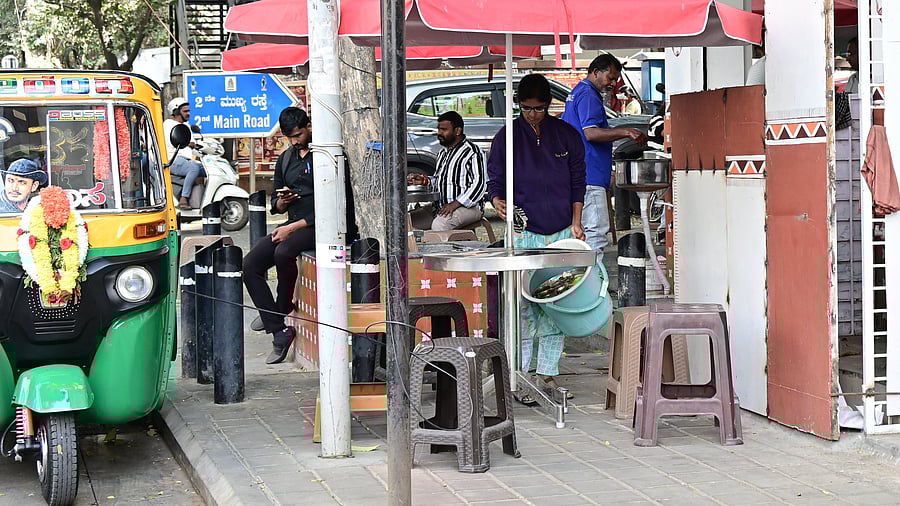
Encroachments on a footpath in Gandhinagar.
Credit: DH Photos/B K Janardhan
On an ordinary weekday afternoon, thousands of pedestrians shuffle along pavements near Gandhinagar and Shivajinagar; students weave past broken slabs at Silk Board, the elderly wobble dangerously close to moving traffic near Hebbal, and desperate walkers near Town Hall risk their lives to reach bus stops.
For a city that prides itself as India’s tech capital, the stark reality is that its streets remain unsafe for pedestrians. Despite ambitious goals of becoming “the most walkable city in India”, pedestrians in Bengaluru are still fighting for space on roads designed primarily for cars, buses, and high-speed traffic.
Recent police data shows that pedestrians account for nearly 28 per cent of all road fatalities in Bengaluru, with over 200 walkers killed annually, a figure that has remained high despite enforcement drives and infrastructure interventions.
At busy intersections, the city’s traffic planning tells a familiar story: tall median grills and rigid dividers have been installed to keep vehicles flowing, but these steel cages also trap pedestrians, forcing them to walk long distances to reach designated crossing points.
A reality check by DH at several junctions such as Sheshadri Road, K G Road, Hosur Road, and Hebbal Road revealed that skywalks, envisioned as safeguards, remain largely inaccessible to the elderly and persons with disabilities because lifts and escalators rarely function. Good footpaths are often blocked by encroaching vendors, garbage heaps, abandoned transformers, or illegally parked vehicles, forcing walkers onto the road, always at the risk of being knocked down by speeding traffic.
Many walkers whom DH spoke to say the problem is not the lack of footpaths, but the lack of willingness to keep them free of obstructions, wide enough for all users, and continuous across the city. In many stretches, pavement slabs are uneven, footpaths are submerged beneath waste or stormwater drains, and vehicles occupy space meant exclusively for pedestrians.
A regular walker near the Silk Board–Madiwala bus stop said, “There is no space for pedestrians as the entire stretch is blocked. It’s extremely dangerous, especially for senior citizens, and during peak hours people are forced to stand amid heavy traffic.”
“The city claims there are pockets of excellent footpaths,” said Arun Pai, coordinator of Walkluru. “But for those commuting to class, work, or hospital on a daily basis, these pockets are exceptions. We’ve documented over 77 kilometres of quality paths, but there are hundreds more that need urgent attention.” Pai believes perceptions are shaped by where people live and that outside select zones, infrastructure still pushes pedestrians into harm’s way.
Pedestrians also point out that even upgraded footpaths often crumble months after completion, as seen in areas like Ejipura, where freshly paved paths deteriorated quickly, raising questions about workmanship and civic accountability.
At the same time, civic activists have welcomed initiatives such as the Hejje-Gala corporate mobility challenge launched by the Greater Bengaluru Authority (GBA), which nudges companies to promote walking and cycling for short commutes and unlocks ground-level data that planners can use to optimise infrastructure.
Despite these daily frustrations, GBA Chief Commissioner M Maheshwar Rao insists the city’s priorities have shifted. The ‘Pedestrian First’ ethos now features in GBA budgets, and coordination between agencies such as water supply, metro, stormwater, and traffic police has improved, he says. The GBA’s goal is to expand high-quality footpaths to hundreds of kilometres in the coming years, with citizen feedback guiding decisions.
Cut-off box - GBA Chief on priorities for pedestrian safety As Bengaluru continues to grapple with gaps in pedestrian infrastructure the city’s top civic officials say priorities are beginning to shift. In an exclusive interaction with DH GBA Chief Commissioner M Maheshwar Rao speaks about delays design challenges and the steps now being taken to improve walking conditions across the city. Why weren’t skywalks prioritised at key pedestrian crossings earlier? Skywalks are identified in consultation with the Bengaluru Traffic Police based on pedestrian volume and road engineering requirements. Nearly 100 such structures have been earmarked and plans to develop them on a public-private partnership basis are underway. What about the broken footpaths and slabs that deteriorate soon after construction? Maintenance challenges stem from limited engineering staff and heavy public use. We plan to recruit more engineers this year and introduce annual maintenance contracts so footpaths are regularly inspected and repaired. How is the city planning to ensure continuous footpaths across major roads? We have launched a programme to improve footpaths on 100 key roads across the city 10 in each corporation zone with dedicated designs for continuity usable gradients and safe crossings. What is your long-term vision for pedestrian safety? Our aim is to integrate active mobility with public transport. Walk-to-bus and walk-to-metro corridors are the future. Pedestrian needs will guide design rather than being treated as an afterthought after traffic engineering. Is there a plan to improve the cycling network and lay cycle paths? Where road width permits we will integrate cycle paths though each route demands independent planning based on space and safety considerations. The commissioner emphasised that for pedestrian safety to improve a “mental switch” is needed where vehicles yield to pedestrians and pedestrians follow rules conscientiously.