
Eleven stations were proposed, including four in Bengaluru and two in Kolar.
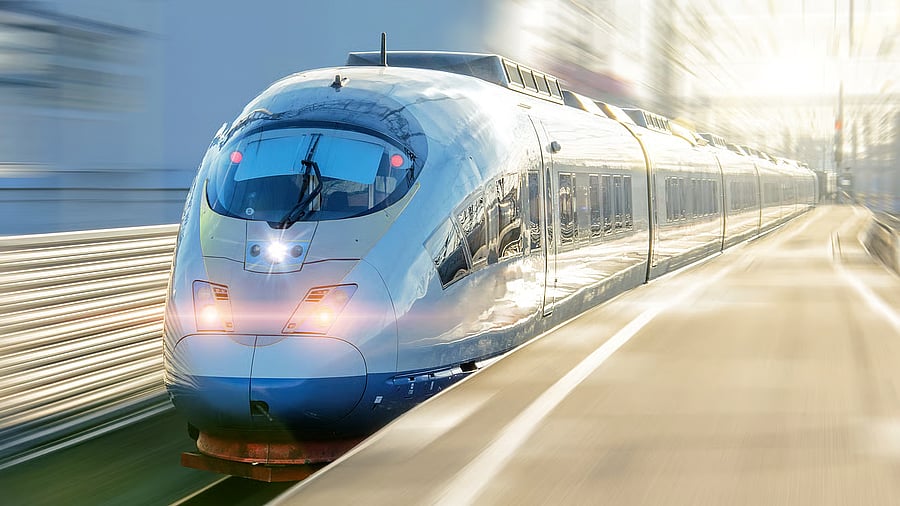
Credit: iStock Photo
Bengaluru: Bengaluru-Chennai and Bengaluru-Hyderabad are among the seven high-speed rail (bullet train) corridors announced in the Union Budget on Sunday.
"In order to promote environmentally sustainable passenger systems, we will develop seven high-speed rail corridors between cities as 'growth connectors', namely i) Mumbai-Pune, ii) Pune-Hyderabad, iii) Hyderabad-Bengaluru, iv) Hyderabad-Chennai, v) Chennai-Bengaluru, vi) Delhi-Varanasi, vii) Varanasi-Siliguri," Union Finance Minister Nirmala Sitharaman stated.
Addressing a press conference later, Railway Minister Ashwini Vaishnaw said the seven corridors would be built with indigenous technology at an estimated cost of Rs 16 lakh crore.
India's first bullet-train project — the 508-km Mumbai-Ahmedabad High Speed Rail (MAHSR) corridor — is being constructed using Japanese Shinkansen technology, engineered for speeds of up to 320 kmph.
Vaishnaw said travel time on the Bengaluru-Chennai corridor would be one hour and 13 minutes, Bengaluru-Hyderabad two hours, Pune-Mumbai 48 minutes and Pune-Hyderabad one hour and 55 minutes.
"Details on alignment and stations will be disclosed after three months," he added.
The Mysuru-Bengaluru leg appears to have been left out of the bullet train project, apparently due to feasibility constraints.
For the original Mysuru-Bengaluru-Chennai project (435 km), National High Speed Rail Corporation Limited (NHSRCL) had commissioned a final alignment design, including aerial LiDAR survey and other related works.
The helicopter-based LiDAR survey, conducted by the AARVEE-GSL consortium at a cost of Rs 8.64 crore, collected detailed topographic data.
Eleven stations were proposed, including four in Bengaluru and two in Kolar.
In Bengaluru, stations were proposed at Kengeri, Electronics City, Baiyappanahalli and Whitefield.
In Kolar, the stations were proposed in Malur taluk and about 5 km from Kolar town towards Mulbagal.
With the Mysuru leg now excluded, Bengaluru may get only two stations, including Majestic and Whitefield.
In July 2024, the Kolar district administration conducted a stakeholders' meeting on the project's social and environmental impact.
A senior state government official who attended the meeting told DH: "A basic survey was conducted to assess land requirements, route alignment and other details. We conducted a meeting with landowners and other stakeholders. Tenders were later floated to prepare the Detailed Project Report (DPR)."
The Bengaluru-Hyderabad corridor is expected to improve connectivity between the two IT hubs, where passengers have long complained of inadequate train links.
Bullet train projects have long gestation periods due to land acquisition hurdles, technical challenges and financing challenges. They run on dedicated tracks that are fenced to prevent unauthorised access.
The 508-km Mumbai-Ahmedabad corridor, approved in May 2014, had achieved only 55% physical progress as of October 2025. Its deadline has now been revised to December 2029.
Going by when the Centre approves the DPR for the new corridors, groundwork may start only in 2027 or later.
The choice of the Bengaluru-Chennai and Bengaluru-Hyderabad routes has drawn criticism, with critics arguing that they would largely benefit other states. They say the Bengaluru-Pune route should have been included as it would serve large parts of Karnataka.