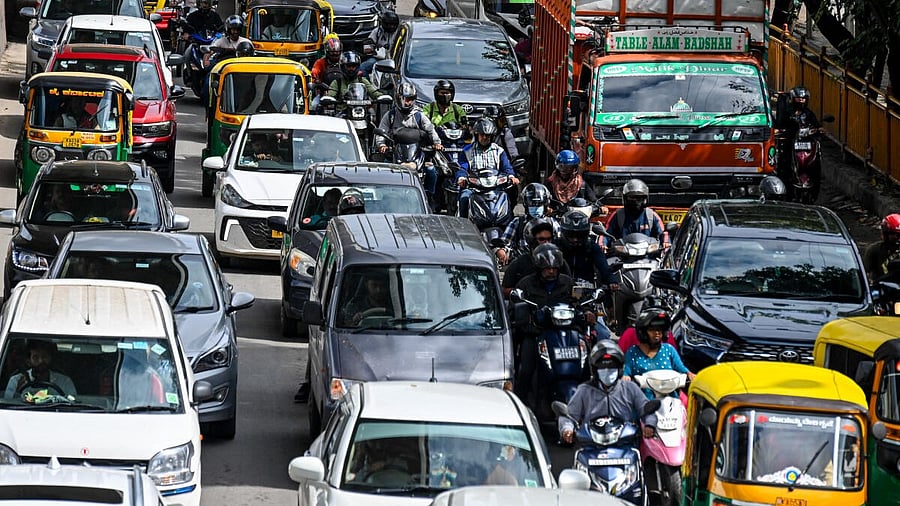
Slow-moving traffic snarls through Bengaluru roads.
Credit: DH Photo
Traffic congestion at key junctions in Bengaluru continues to be a headache for both commuters and police, especially during peak hours, with some of the intersections witnessing cumulative queues extending more than 10 km.
The city’s busiest traffic corridors are struggling to cope with ever-increasing vehicle inflow, worsened by ongoing construction projects, including metro work and infrastructure upgrades.
According to latest traffic data, Gokaldas Images Junction and Veerannapalya are the city’s worst congestion hotspots. In the mornings (8 am to 12 pm), Gokaldas Images Junction in North Bengaluru sees traffic queues reaching 9.9 km. In the evenings (5 pm to 9 pm), Veerannapalya Junction near BEL tops the list with a massive 15.8 km congestion on an average.
While commuters often imagine a single straight line of cars, the Bengaluru Traffic Police (BTP) calculate these figures using the "Network Effect" via the ASTraM (Actionable Intelligence for Sustainable Traffic Management) platform.
The "Avg. Congestion Length" is the sum of traffic tails on all approach roads (arms) of a junction.
For example, Veerannapalya’s 15.8 km figure represents the combined length of jams on the various roads feeding into the junction. Calculated over the 4-hour peak window. These lengths are tracked every 15 minutes using AI-powered cameras and GPS probe data.
Joint Commissioner of Police (Traffic) Karthik Reddy explained to DH that the situation was exacerbated by the metro construction in Veerannapalya, which has slowed down traffic even further. “The infrastructure works at Hopefarm and Silk Board Junctions have led to significant congestion,” said Reddy.
Traffic at Goraguntepalya Junction and Kundanahalli Gate Junction is particularly problematic due to heavy vehicle inflow. The situation is dire at Goraguntepalya because vehicles from 20 districts converge on this junction.
The JCP (Traffic) highlighted that while weekends see families out in full force, there is a midweek “peak” driven by corporate work-from-office mandates. “Tuesday and Wednesday are the heaviest for peak hour traffic,” he noted.
“With many employees taking Monday or Friday offs for long weekends, the midweek period sees the maximum convergence of the city’s workforce on the roads.”
Reflecting on the challenges of redesigning these hubs, Reddy said candidly: “Traffic can neither be created nor destroyed; it can only be moved. It’s like a leak if we tighten it at one junction, it leaks at another. We are currently conducting trials at Kundalahalli to see if we can stem the flow, but it often just shifts the jam elsewhere.”
The solution
Reddy also reiterated the need for carpooling, staggered office timings to spread the peak hour load and more public transport usage for daily commutes. “If we reduce the number of private cars by even 10%, the impact on the Outer Ring Road would be massive,” he added.
In a bid to tackle the issue, traffic police have been experimenting with changes in signal timings, especially in areas like Hopefarm.
“We have seen some improvement after modifying signal timings at Hopefarm,” Reddy noted.