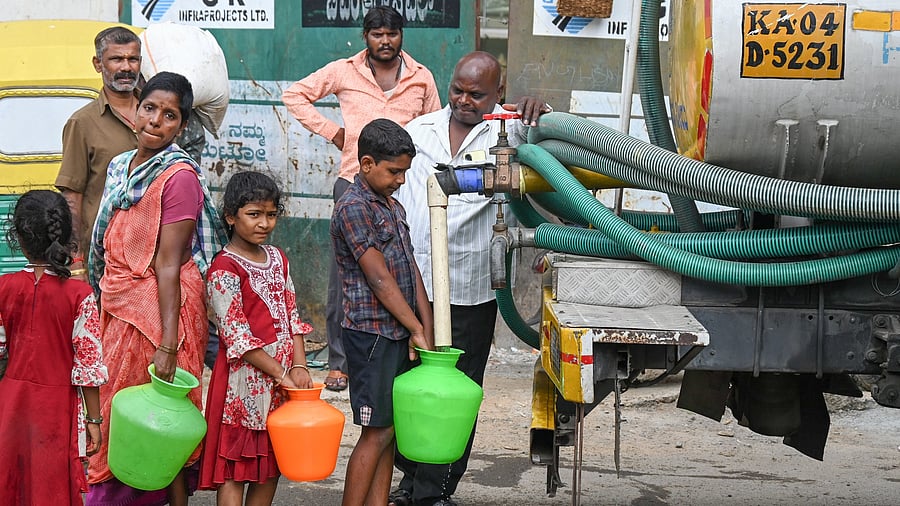
Soaring temperatures and drying borewells led to an acute water crisis in Bengaluru during the summer of 2024.
Credit: DH FILE PHOTO
Bengaluru: Aiming to ensure there is no water shortage in the city this summer, the Bangalore Water Supply and Sewerage Board (BWSSB) has started preparations.
The board has prepared an action plan to address any shortage that could arise during the summer.
Among the major concerns officials are trying to address is the increase in demand that could result from the drying up of borewells.
To address this, the BWSSB has begun an analysis of groundwater levels in the city in collaboration with the Indian Institute of Science (IISc).
"The data will help us understand which areas might be under stress during the summer. We can start preparing now to address any shortfall," BWSSB Chairman Ramprasat Manohar V told DH.
Senior BWSSB officials told DH that many areas in the city's periphery heavily depend on borewell water and, as many are yet to take Cauvery water connections, these areas might face water shortage.
"Many of them are yet to take connections under Cauvery Stage V, though it was inaugurated nearly a year ago. Those areas might face some problems," the official said.
Officials have also been asked to identify areas which had water shortage in 2024.
"In 2024, we set up small water supply systems in many areas where the population of the urban poor was high. We will follow the same model this year as well," Manohar said.
Sanchari Cauvery service
The BWSSB will also increase water supply through the Sanchari Cauvery service to areas that face water shortage.
"We will also ensure that the use of treated water is promoted extensively and aerators are installed on all taps in public places to reduce water wastage," Manohar added.
However, officials felt that the problems will become evident only if the summer is very harsh.
In 2024, the city experienced a harsh summer with temperatures reaching nearly 40 degrees Celsius. The demand for water increased due to the rise in temperature, while dry borewells increased dependence on Cauvery water.
As a result, the city faced an acute water crisis, forcing authorities to implement remedial measures.